
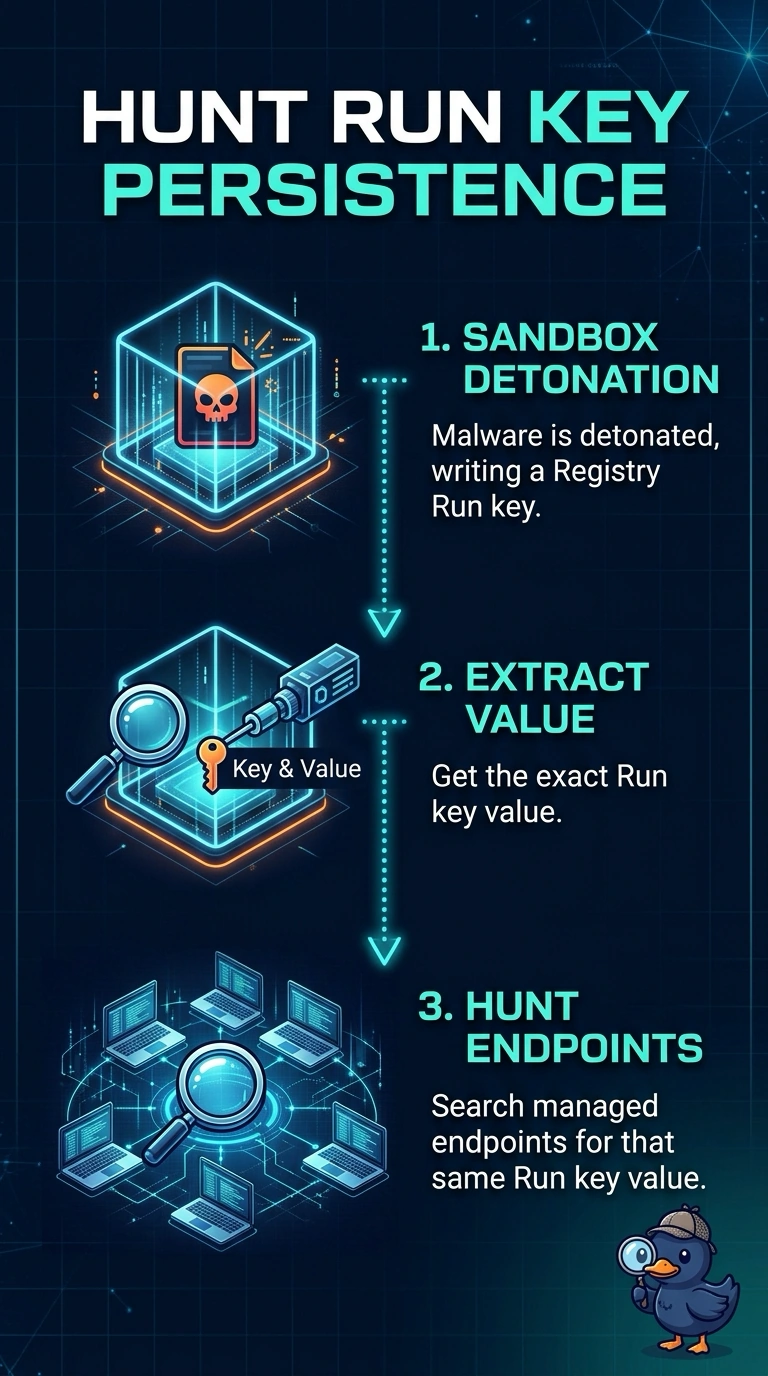
A hospital review of a Secure Malware Analytics report shows the sample created a new Run key during detonation. What persistence hunt belongs on the enterprise, outside that sandbox?
Select an answer to reveal the explanation.
Short Explanation
Picture the sandbox as a firing range, not the hospital ward. You take the new Run key from the report and search real computers for that same persistence. Don't treat the lab machine as the victim or close the case by cleaning only the range.
Full Explanation
Registry activity in a Secure Malware Analytics detonation records what the sample changed on the guest, and a new Run key is a persistence lead from that run. The enterprise step is to search managed endpoints for the same Run key value written during detonation and learn whether any production host holds it. The analysis guest is not the patient. Choosing to isolate the analysis virtual machine and treat that sandbox as the victim host swaps the lab cage for the hospital; that virtual machine exists to execute samples, and isolating it does not locate infected systems. Choosing to delete the Run key inside the sandbox registry and close the incident as remediated discards a lab artifact and calls the incident remediated without a fleet hunt. Choosing to treat the new Run key as proof the sample already ran on every domain controller inflates one sandbox behavior into domain-wide execution; a domain controller is in scope when that host shows the key or the file. Exam caveat: sandbox registry activity documents an attempt inside the analysis guest, not a roster of enterprise victims. Operational check: copy the exact Run key value from the report and search endpoint registry telemetry for hostnames that return a match.