
A hospital application server is online again from a snapshot taken while the attacker still had access to that host. Why has this recovery not reached a trusted state?
Select an answer to reveal the explanation.
Short Explanation
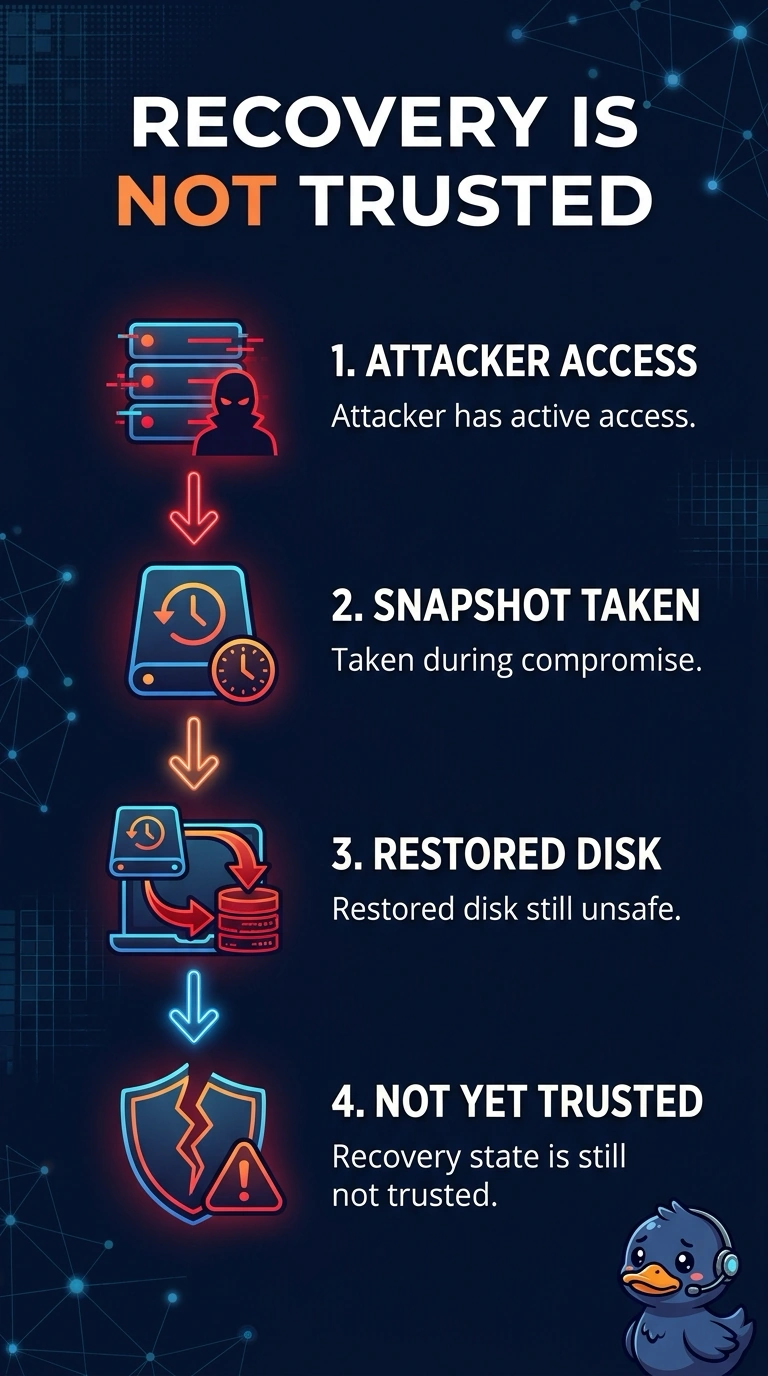
Putting the same sick plant back in the garden does not make the garden healthy. You restored a snapshot from the compromise, so the disk is online and still not trusted. Health checks and a familiar network address only show that the server answers, not that it is clean.
Full Explanation
A trusted recovery returns a system to a known-good condition, not merely to a running one. The snapshot dates from the compromise, so the restored disk is still not a trusted state: accounts, tools, and persistence that existed while the attacker had access come back with it. A storage-only snapshot does not capture RAM; some VM snapshots can include memory. Either may preserve compromised state and must not be assumed clean merely because the restored application runs. Any snapshot restore does not count as trusted once the application answers health checks and staff can sign in, because availability is not integrity. Trusted state is not reached as soon as the server is placed back on the production network; the address only shows where it sits. A snapshot taken during the intrusion is not safer than a backup from before the attacker arrived, because newer and compromised loses to older and clean. Exam caveat: if no pre-incident backup exists, rebuild from a known baseline and rotate credentials rather than calling this snapshot a cure. Operational check: compare the snapshot time with the first evidence of attacker access and restore from a point before that, then confirm the recovered host does not still contain the attacker's accounts or tasks.