
Malware was deleted from a retail laptop, but the compromised VPN credentials and malicious sessions remain valid. Why is eradication incomplete?
Select an answer to reveal the explanation.
Short Explanation
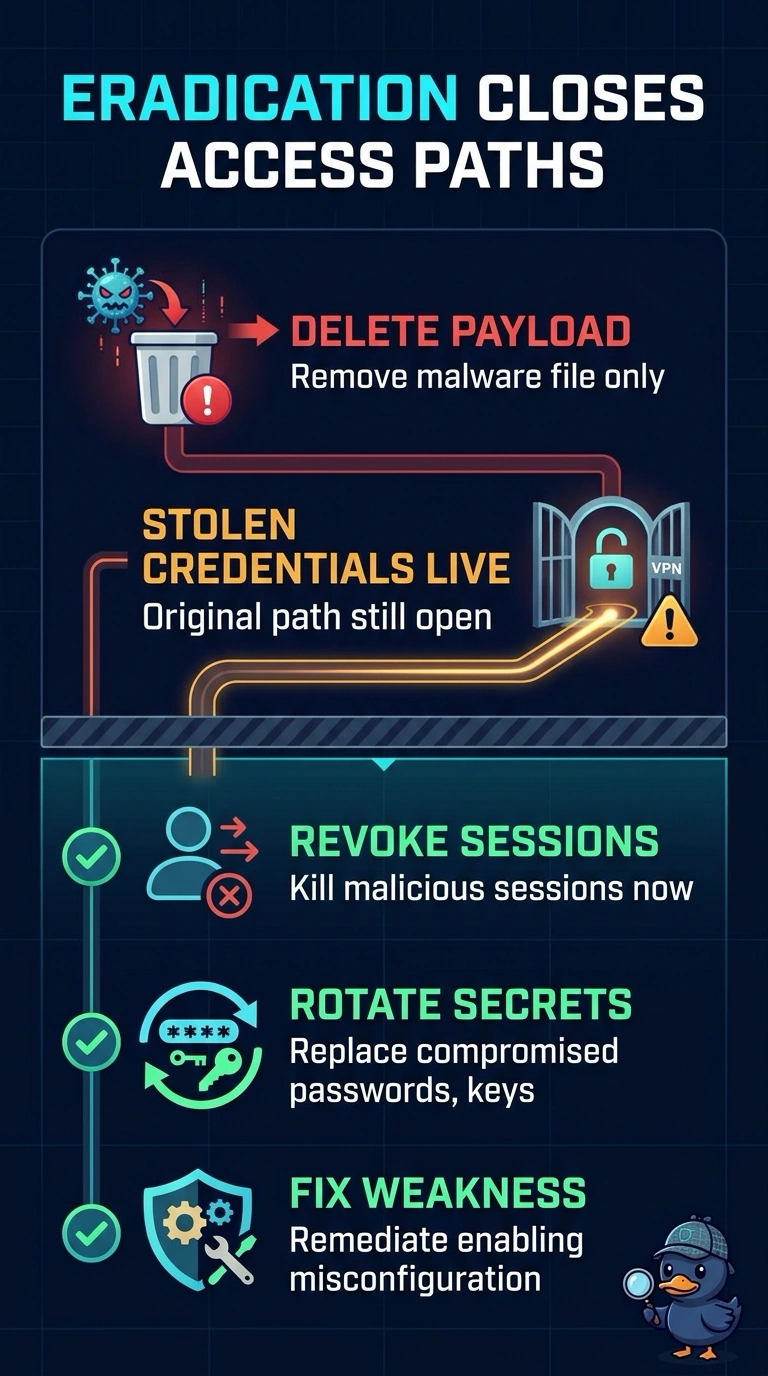
You wiped the file but you left the stolen keys on the table. You deleted the malware, yet the compromised credentials and sessions remain valid so the original path is still open. Revoke malicious sessions, rotate compromised credentials and fix the enabling weakness; MFA strengthens access but its absence alone does not prove that prior attacker access remains valid.
Full Explanation
Eradication means the attacker cannot return by the same path. Deleting the malware file removes one payload from the retail laptop, yet the compromised VPN credentials remain valid, so the original access path is still available, and malicious sessions remain valid for reuse. Revoke malicious sessions, rotate compromised credentials and fix the enabling weakness; MFA strengthens access but its absence alone does not prove that prior attacker access remains valid. The idea that cleanup ends with file deletion is wrong because valid stolen credentials are an independent persistence path that survives endpoint cleanup. The idea that only another malware file on the same laptop keeps eradication incomplete is wrong because eradication spans accounts, sessions, and access vectors, so a clean disk with an open door is still unfinished. The idea that deleting a file resets authentication is wrong because endpoint deletion has no authority over identity providers and does not invalidate tokens or rotate secrets. Exam caveat: file removal was necessary but not sufficient while compromised access remains usable. Operational check: verify the VPN sessions are revoked, credentials are rotated, and the enabling weakness is remediated before marking eradication complete.