
A hospital workstation is still powered on, and a pagefile is present on disk. Why does a live RAM capture remain the primary memory artifact, with the pagefile as a supplement?
Select an answer to reveal the explanation.
Short Explanation
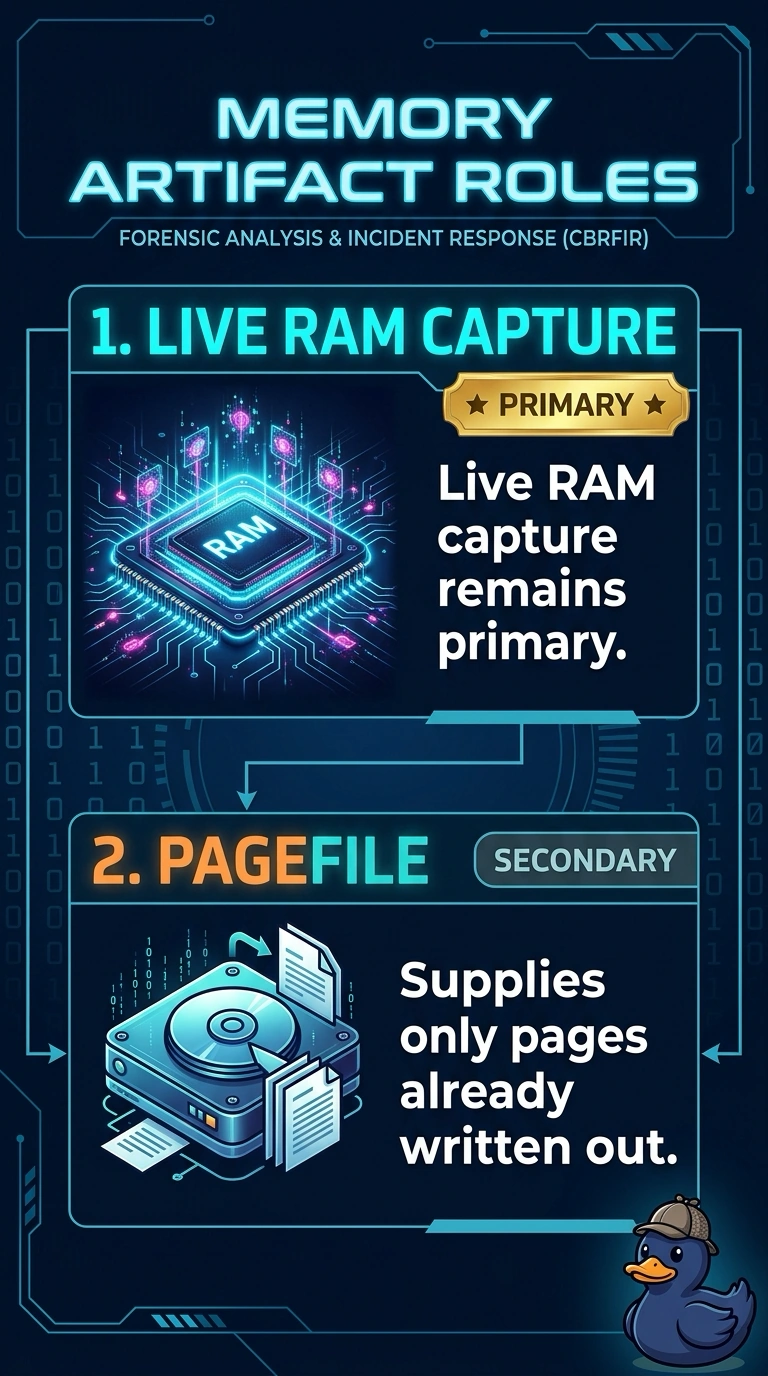
A photo of the whole room beats hoping a scratch pad on the desk copied every note. You take a live RAM capture as the primary memory artifact while the host is on, and you keep the pagefile as a supplement. The trap is treating the pagefile as a full copy of RAM, or waiting for hibernation before any capture.
Full Explanation
A live RAM capture is a picture of the current address space: running processes, connections, and injected code that has not been written to a file. Keep the live RAM capture primary, with the pagefile supplying only pages already written out. The pagefile is a supplement because the memory manager writes some pages to disk and leaves the rest in RAM. Treating the pagefile as a complete copy of RAM, so collecting that file replaces a live memory image, overstates what was paged out. Imaging the pagefile alone and expecting it to hold current network connections and the full injected code makes the same mistake. Connections and much of the active image are not guaranteed to be among the pages written out. Hibernating the host before capture, on the view that hibernation is required while the machine stays on, is unnecessary. A powered-on host can be acquired live, and hibernation is a different memory file created only when the system hibernates. Exam caveat: the pagefile can still hold fragments of older pages, so it is worth keeping after the RAM capture, not instead of it. Operational check: compare the process list and any injected regions in the live capture with the pagefile, and show active memory that the pagefile does not fully contain.