
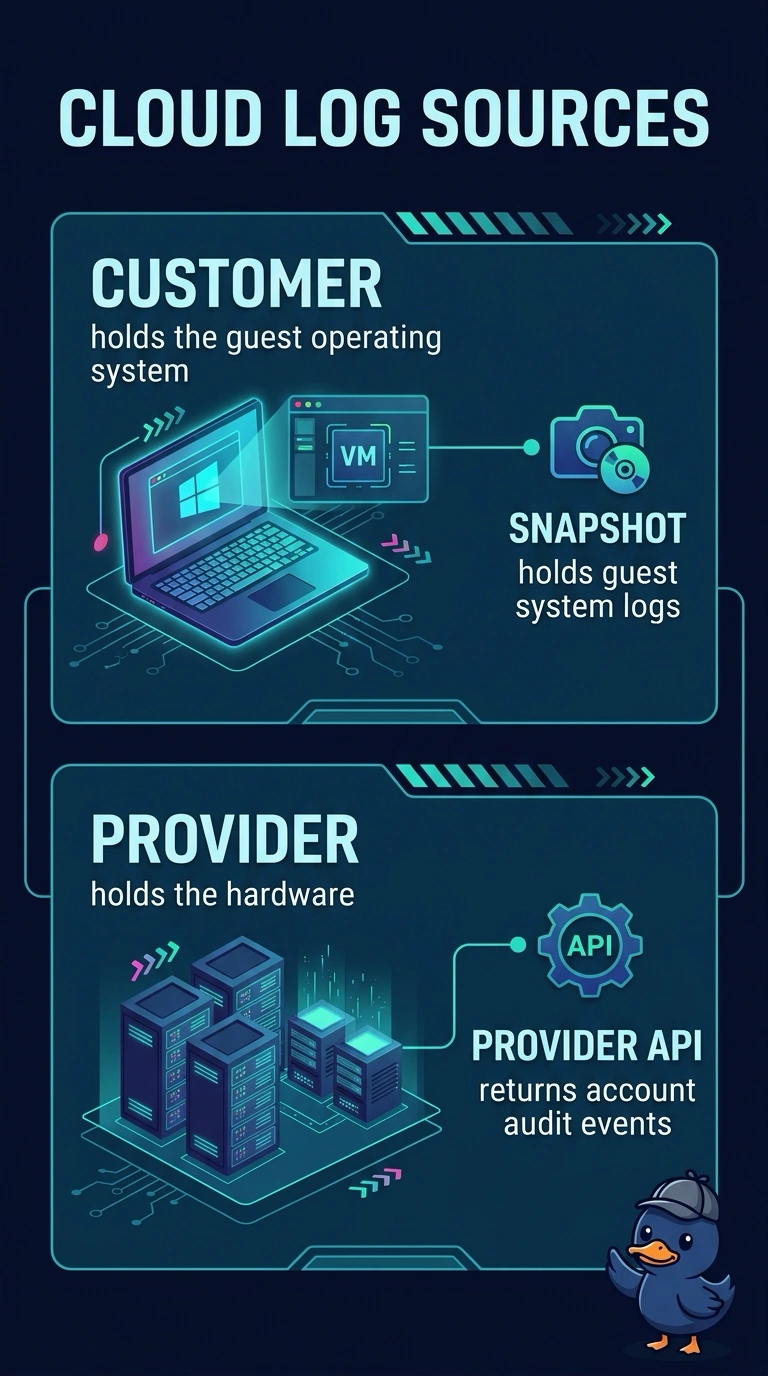
A cloud virtual machine is compromised: the provider holds the hardware, and the customer holds the guest operating system. Which logs come from the provider API, and which come from a guest disk snapshot?
Select an answer to reveal the explanation.
Short Explanation
The lobby visitor book and the diary in your office are different notebooks, and you fetch each one from the place it is kept. The provider API is where you pull account audit events, and the guest disk snapshot is where the guest system logs reside. Swapping those sources, or expecting either one to be a hypervisor memory image, mixes the control plane with the guest.
Full Explanation
The provider API returns account audit events, and the snapshot holds guest system logs, because those are different owners and different stores. Account audit events record control-plane actions on the customer account, which you pull from the provider side. Guest system logs sit on the guest disk, which you recover from the snapshot. It is backwards to claim the provider API returns the guest system logs and the snapshot returns hypervisor dumps. It is also wrong that the provider API and the guest snapshot both supply the same hypervisor memory image; neither artifact is the provider host memory. The guest snapshot contains no neighboring tenants audit events from the provider plane; isolation keeps that material out of your disk copy. Exam caveat: a guest agent may have forwarded some logs to a cloud logging service, and those copies are still a different store from the snapshot and from the account audit trail. Operational check: open one API audit event and one log file from the snapshot and confirm the first is an account action while the second is a guest system record.