
A dropper XOR-obfuscates a plaintext configuration with one unknown repeating byte. Which named tool is meant to recover that short key from the ciphertext?
Select an answer to reveal the explanation.
Short Explanation
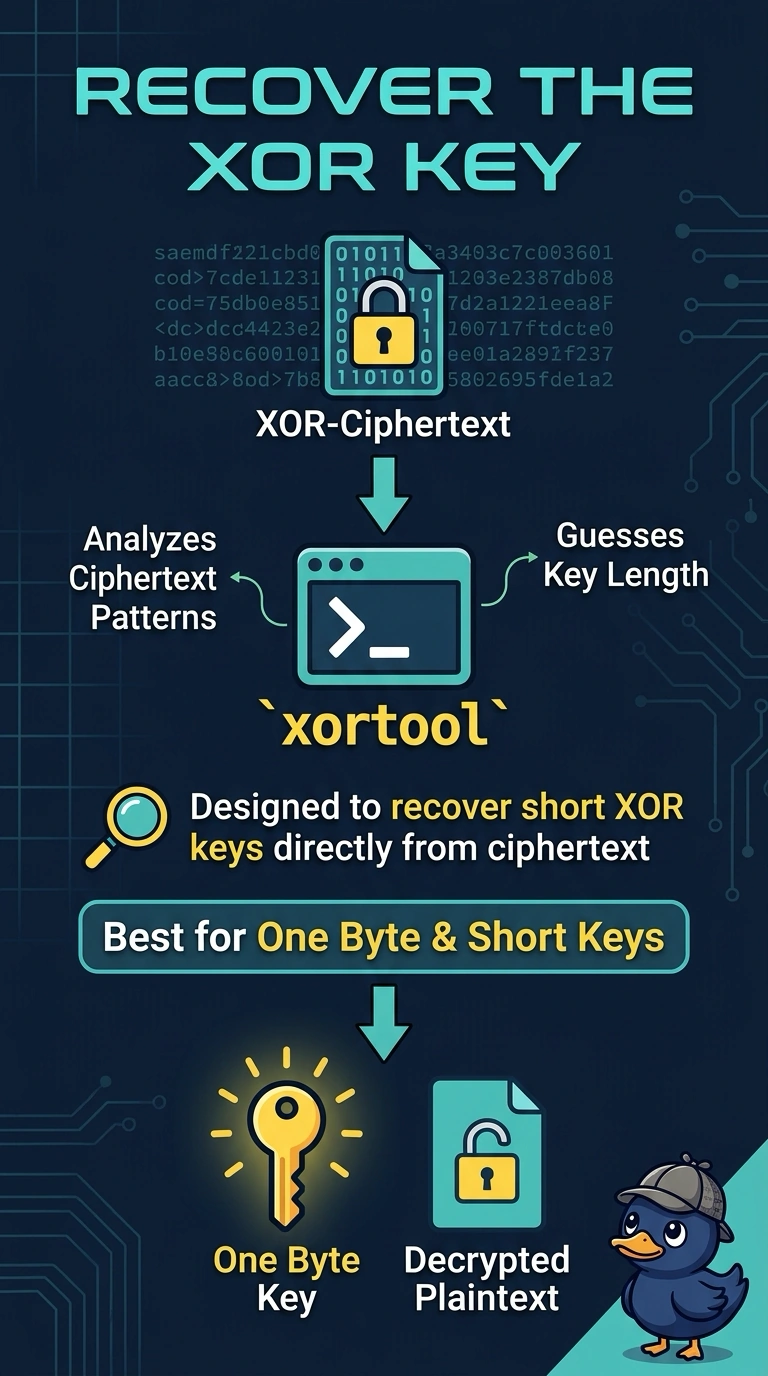
A one-byte XOR key is a tiny padlock, and xortool is the pick made for that lock. You point xortool at the ciphertext to recover the short key. An unpacker, a decompiler, or a Base64 decode answers a different hiding trick.
Full Explanation
xortool is aimed at recovering a short XOR key directly from ciphertext, using byte frequency on the encoded blob rather than executing the dropper. A single unknown byte is the classic short key that workflow is meant to recover, after which the config can be decoded and read. XORBruteForces used as an unpacker that must remove a packer stub before any XOR test misstates that tool: brute-forcing keys is not unpacking, and a one-byte XOR blob does not require a packer stub to be removed first. Ghidra decompiler output treated as the recovery method for a one-byte XOR key skips the key recovery; decompilation shows code, it does not by itself guess the XOR byte in the config blob. A plain Base64 decode of the blob performed before any XOR key is considered treats an encoding as if it were the cipher. The stated transform is XOR, not a Base64 layer. Exam caveat: after the key is known, decode the blob and only then decide whether a later brute-force tool is still needed for a longer repeating key. Operational check: Test candidate keys and verify the decoded configuration’s expected syntax; do not expect a change in entropy from single-byte XOR.