
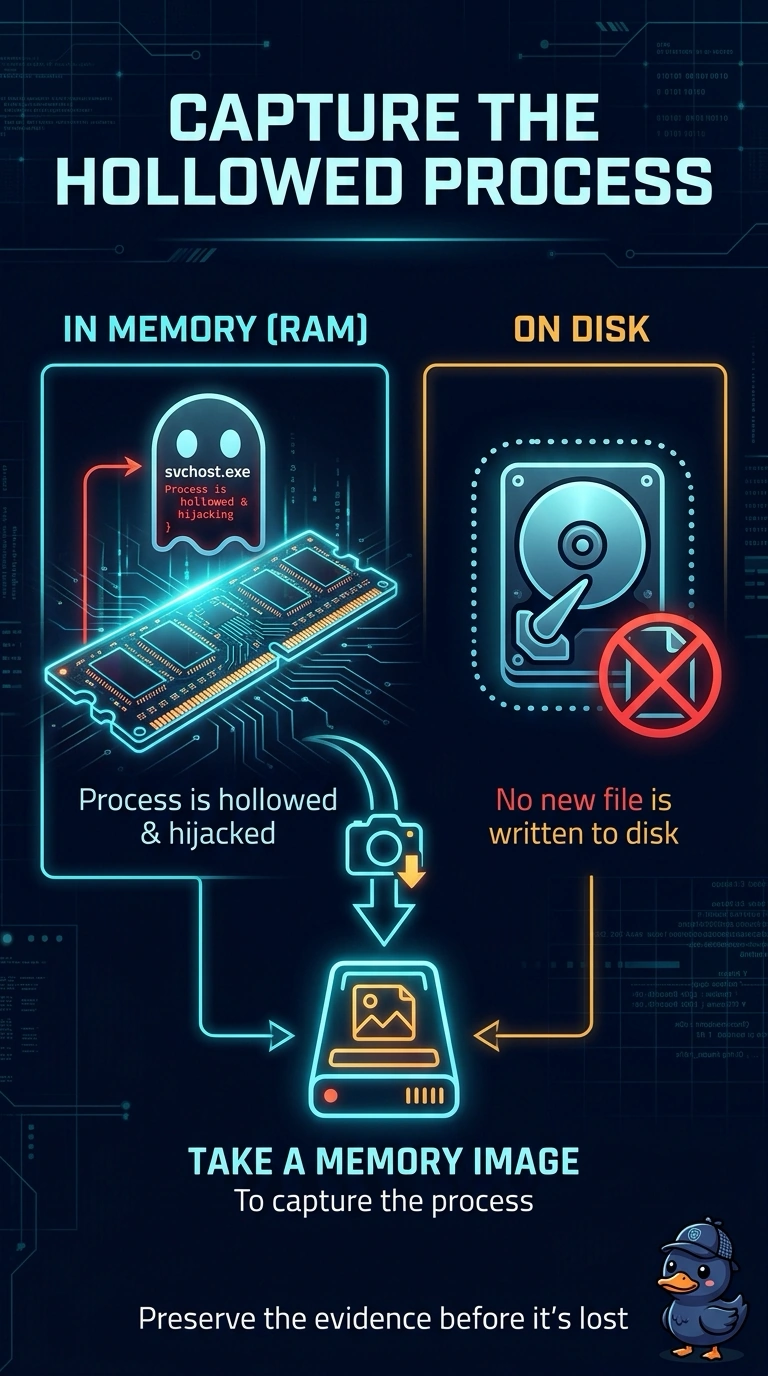
EDR on a software-company laptop shows a hollowed process and no new executable written to disk. Why is a memory capture the evidence that disk imaging will miss?
Select an answer to reveal the explanation.
Short Explanation
Think of it like you photograph the whiteboard while the writing is still on it, because a picture of the empty desk will not bring the notes back. A disk-only acquisition does not preserve the complete live process address space; pagefile, hibernation or crash-dump data may retain some memory pages, so preserve those too. Capture RAM promptly for the hollowed process rather than rely on a new payload file.
Full Explanation
Process hollowing starts a legitimate process and replaces the image in its address space. The malicious bytes live in memory. Take a memory image, the capture that holds the hollowed process when no new file was written. A disk-only acquisition does not preserve the complete live process address space; pagefile, hibernation or crash-dump data may retain some memory pages, so preserve those too. Capture RAM promptly for the hollowed process rather than rely on a new payload file. Taking a disk image first, expecting hollowing to have written a new payload under Program Files, assumes a file drop that the EDR finding already rules out. Taking a cloud disk snapshot, expecting it to include the live process address space on the host, confuses a disk-only copy with RAM; a snapshot of the volume is not the process address space. Reading Prefetch and the MFT, expecting those records to contain the injected code without a new executable, overreads two disk artifacts. Prefetch notes that a file ran, and the MFT records file metadata. Neither stores the replaced image. Exam caveat: if the attacker also dropped a file, the disk image matters for that file, but for the hollowed image itself prioritize RAM plus pagefile, hibernation or crash-dump data. Operational check: compare the in-memory image of the hollowed process with the on-disk file at the same path and show the bytes differ.