
An energy company must decompile a Linux ELF to C-like pseudocode on a machine that will not execute the sample. Why is Ghidra the fit rather than Evan's Debugger?
Select an answer to reveal the explanation.
Short Explanation
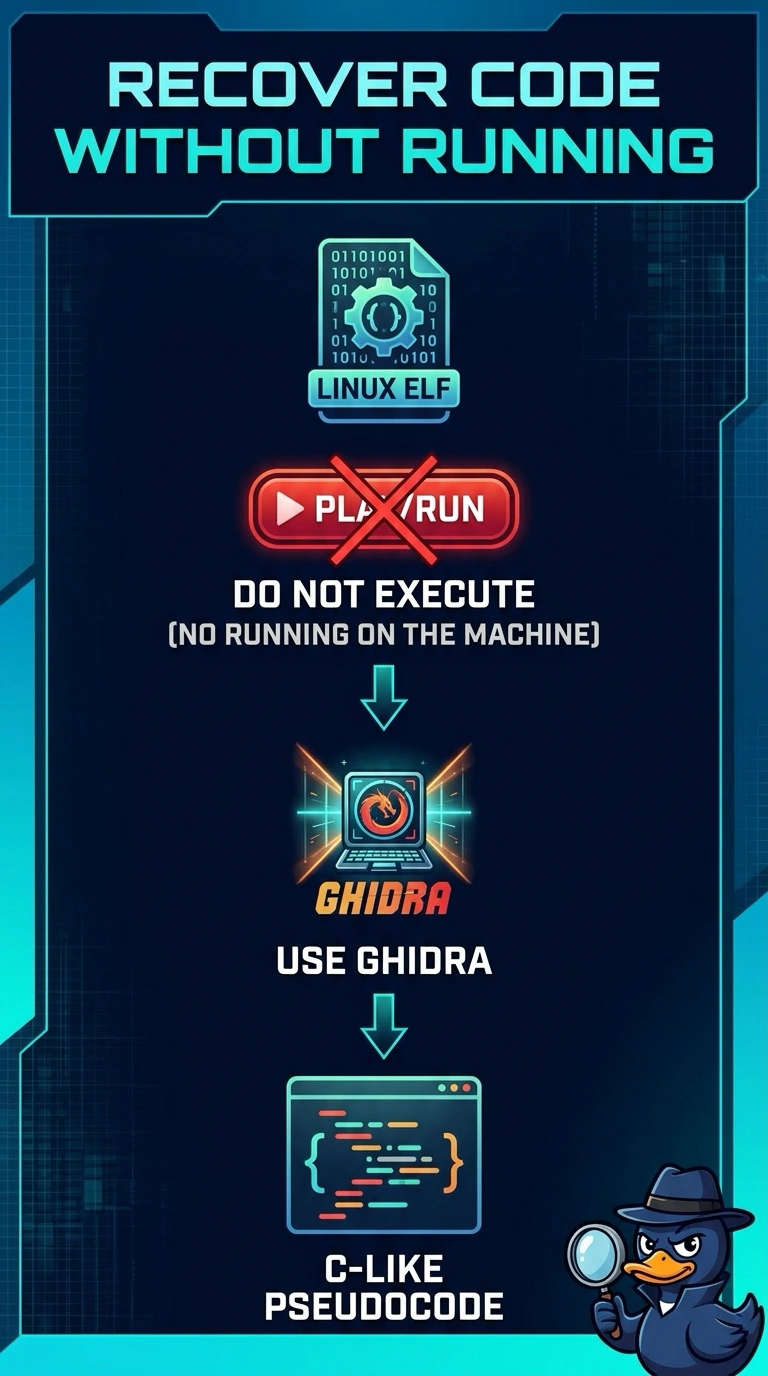
You want a translator who reads the book in plain language without making the actors perform it. Ghidra recovers C-like pseudocode from the ELF without executing the sample, which is why it fits and Evan's Debugger does not. A hex rewrite and an XOR tool do not produce that decompilation.
Full Explanation
Ghidra loads the ELF and recovers C-like pseudocode in its decompiler without executing the sample on that machine, which matches a host that must not run the file. The decompiler lifts disassembly into a C-like view so you can read logic while the executable bit stays unused. Use edb on the analysis machine and step the ELF so live registers can feed a decompiler is Evan's Debugger, and stepping executes the sample under the debugger, which violates the condition. Use HxD to rewrite the ELF header until those bytes resemble C source stored on disk confuses a hex editor with a decompiler; changing header bytes does not produce pseudocode. Use xortool to recover a short key and treat the decoded blob as finished pseudocode applies an XOR-key tool to a problem that is decompilation, not a short XOR key, and the decoded blob is not a decompiler listing. Exam caveat: decompiler pseudocode is an approximation of the logic, not the vendor's original source, so you still confirm important branches in the disassembly. Operational check: import the ELF into a Ghidra project on the analysis machine, open the decompiler, and confirm the sample was not launched and edb is not attached to it.