
A production file server may be running a packed binary that includes an anti-debug check. Why should static work in Ghidra come before any debugger is attached on that server?
Select an answer to reveal the explanation.
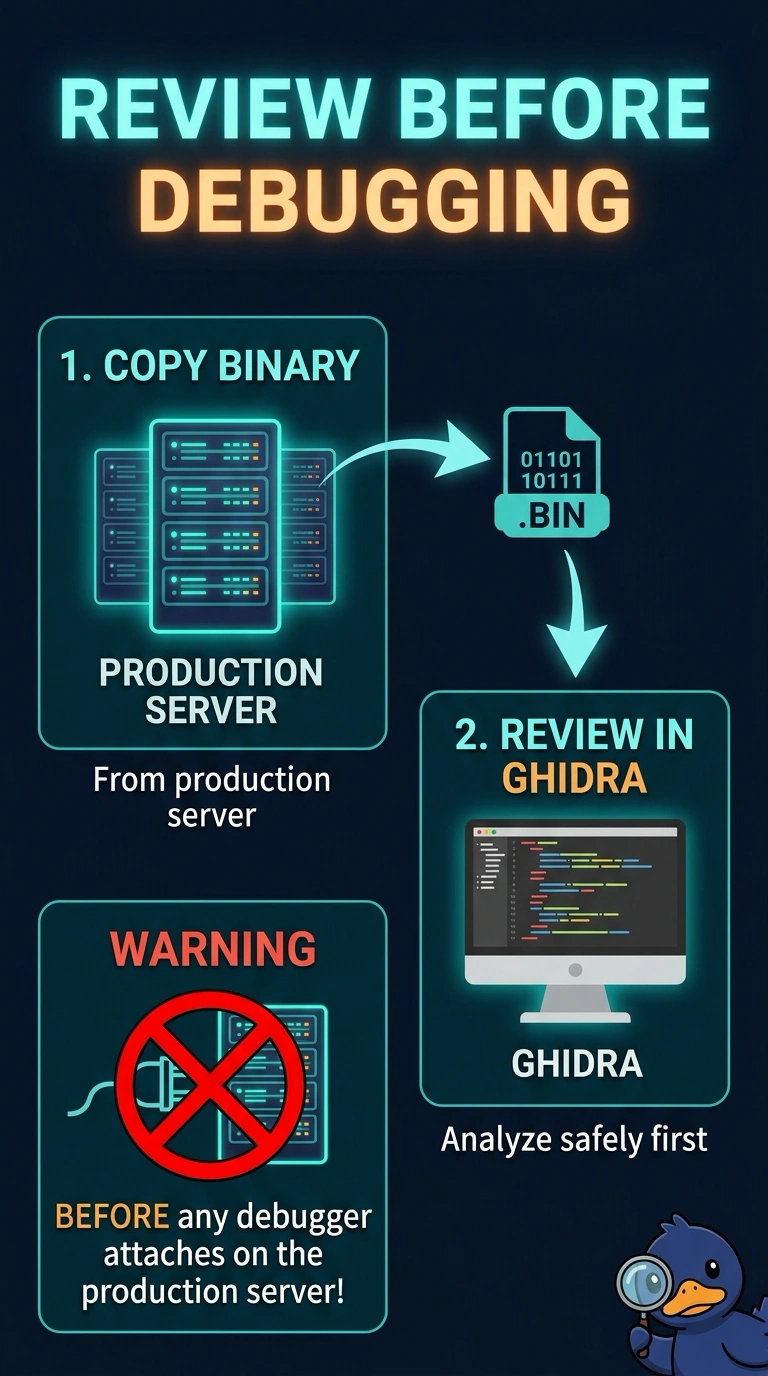
Short Explanation
You keep the production file server safe by reviewing a copied binary in Ghidra before any debugger attaches. That static review lets you inspect anti-debug logic without triggering it on the live server. Save debugger work for a lab session, not the production host.
Full Explanation
Anti-debug checks look for a debugger, unusual timing, or related runtime clues, and they can change behavior or exit when they detect one. Review a copied binary in Ghidra before any debugger attaches on the production server so your first look is static: disassembly and decompilation of a copy, with the live file server left alone. Attaching Evan's Debugger on the production server to catch the anti-debug branch means executing the packed binary under a debugger on the system you are trying to protect, exactly what an anti-debug check is built to notice. Launching the binary from the file share so staff can watch the process together still detonates it in production; an audience does not make that safer. Running xortool across the whole volume before the packed file is copied off the host aims a XOR-key tool at an entire disk instead of taking a copy for static review. Exam caveat: a debugger session can still be useful later inside an isolated virtual machine, after the static pass and never on the production server. Practical check: hash the copied file, open that copy in Ghidra, and confirm no debugger process is attached to the production file server.