
An analyst asks whether running a YARA rule against a quarantined sample will detonate that sample. What does YARA actually do when the rule runs?
Select an answer to reveal the explanation.
Short Explanation
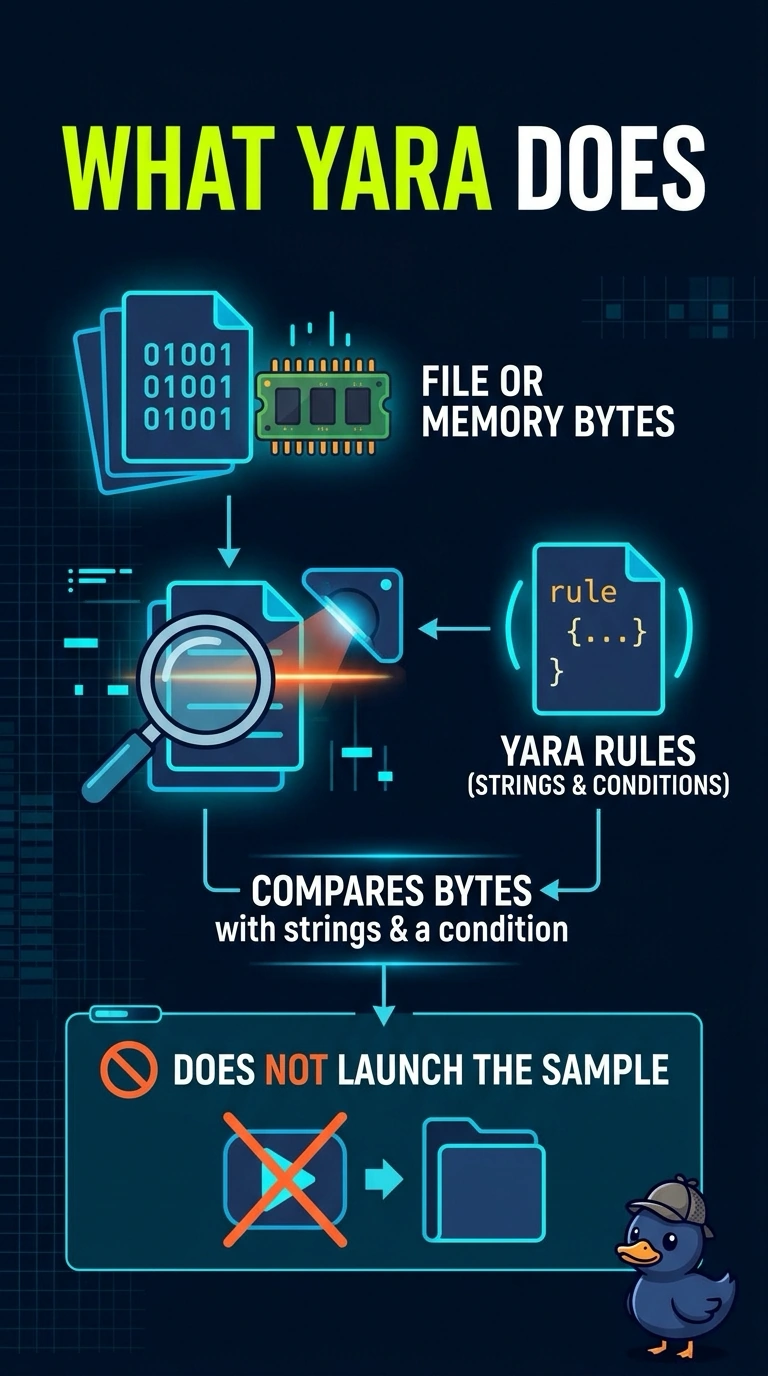
Think of YARA as a detector, not a starter for the sample. When you run a rule, it compares file or memory bytes with strings and a condition; it does not launch the sample. Detonation, decryption, and blocking transfers with a firewall hash are different actions.
Full Explanation
YARA reads file or memory bytes and evaluates strings against a condition. A match means the pattern was present in the bytes you scanned; the sample does not need to run, and running the rule does not launch it. Detonating the sample in a sandbox to produce behavioral indicators and a threat score is a separate analysis activity: those results come from observing execution, not from matching bytes with a YARA rule. Decrypting the sample on disk and writing a cleaned copy back to its original folder is also not what the rule does; a pattern match does not modify or remediate the file. Installing the sample hash on every firewall to deny matching transfers at the edge is a separate response action, not a YARA scanning function. These actions may be considered elsewhere in an investigation, but they are not performed by running the rule. Exam caveat: running a rule is a scan, not a detonation, even when the quarantined file is malware. Practical check: run the rule in a scanner against the quarantined file, review its reported matches, and confirm the sample does not launch a new process during the scan.