
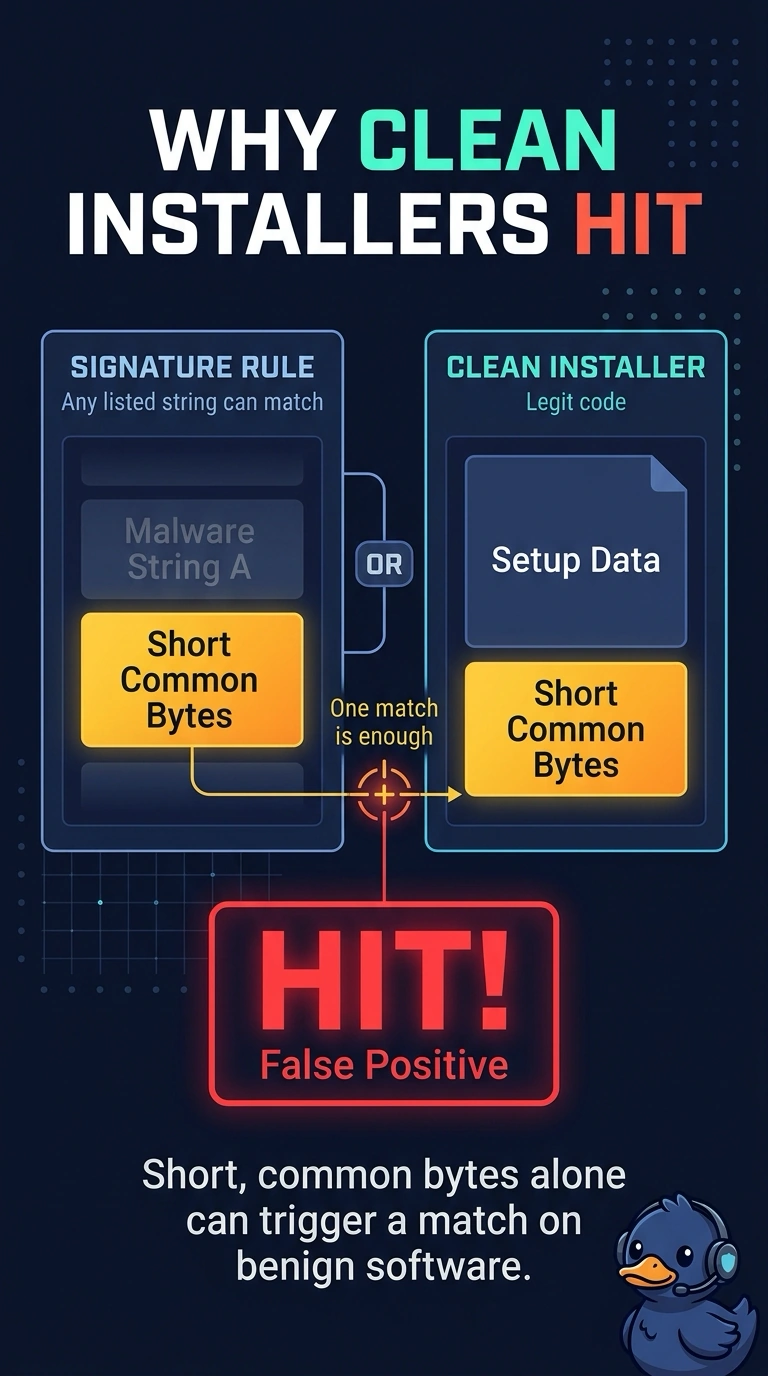
A YARA rule lists a unique mutex and a short common byte sequence, and the condition is any of them. Why can this rule hit a clean installer?
Select an answer to reveal the explanation.
Short Explanation
Any of them is a wide door: one matching brick is enough to walk through. You can hit a clean installer when the short common bytes match, even though the unique mutex is missing. A condition that demanded both strings would not behave this way.
Full Explanation
When the condition is any of them, a single matching string makes the rule hit. Any listed string can match, so the short common bytes alone can hit a clean installer that did not contain the unique mutex; ordinary installers share short byte sequences such as common headers. The meta section does not force a hit on installers that share the rule author's name; meta is a label, and the author's name is not the matcher. The mutex string is not handled as a wildcard that matches ordinary clean software; a specific mutex string matches that string, and the false hit comes from the other, common pattern plus a loose condition. It is the opposite of any of them to say the condition requires both strings, so a clean installer must also contain the mutex string; if both were required, the missing mutex would spare the installer. Exam caveat: any of them is convenient and noisy, and a unique string does not rescue a rule that also accepts a very common byte sequence. Operational check: run the rule on a known-clean installer that lacks the mutex and confirm the common bytes alone produce the hit, then tighten the condition to require the mutex.