
A factory maintenance script stores shellcode as pairs of hexadecimal characters inside one long string. What transformation turns those characters back into the original bytes?
Select an answer to reveal the explanation.
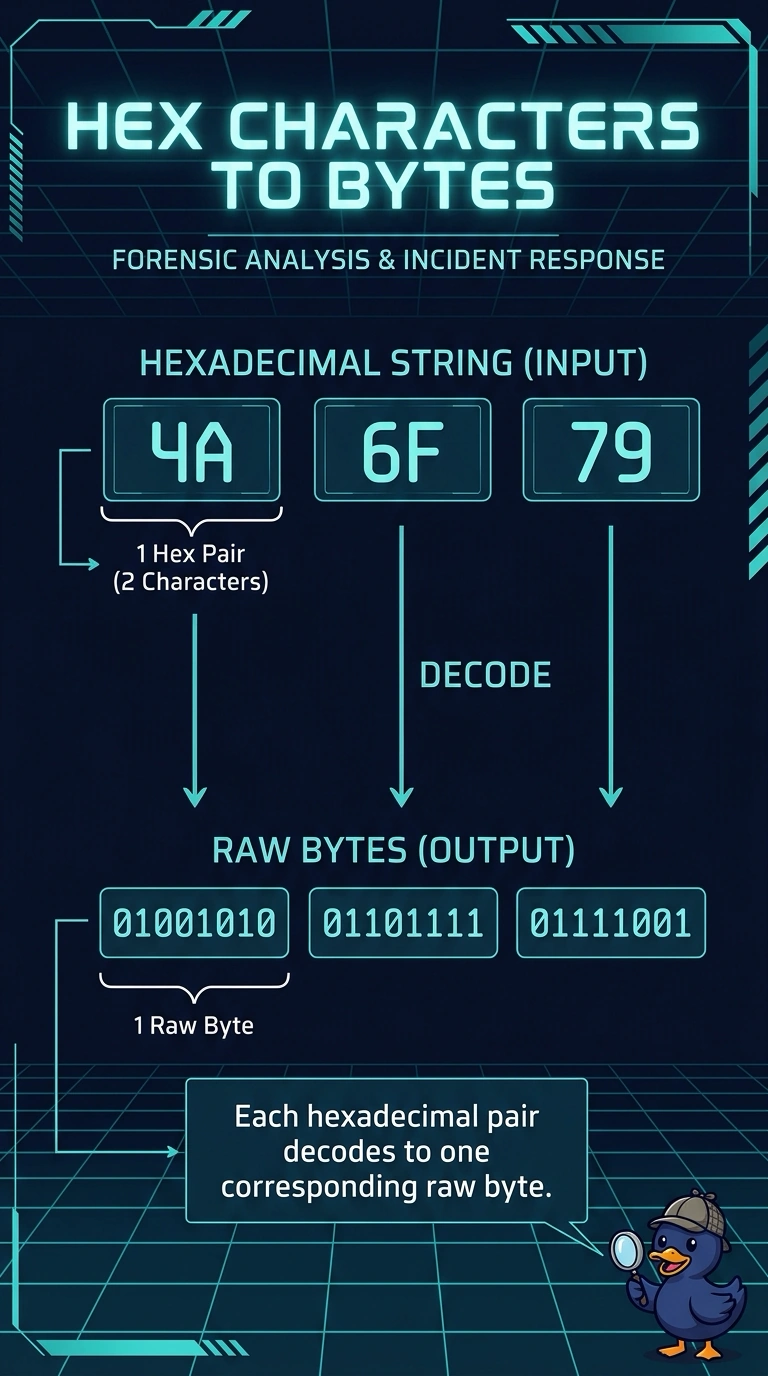
Short Explanation
Those hex pairs are a spelling of the bytes, like writing a color as digits instead of paint. You get the shellcode back by decoding each pair, and no secret is involved. Reaching for base64 or a decryption key is the trap when the text in front of you is hexadecimal.
Full Explanation
Pairs of hexadecimal characters are a public encoding of raw bytes: each pair maps to one byte by a fixed alphabet, and reversing that map restores the shellcode. Counting the pairs is the sanity check, because the byte length should be half the hex character count. The correct step is to decode each hexadecimal pair in the string back into the corresponding raw byte. A Base64-decode of the string, treating every character pair as an alphabet symbol, applies the wrong alphabet; base64 groups are not hexadecimal pairs, and the characters here are hex digits. To decrypt the string with a secret key stored in a comment assumes encryption, but no key is required to reverse a hex encoding and a nearby comment is not key material. To decompress the string as a packed archive assumes a compression wrapper, which is a different problem from reading an encoded byte string. Exam caveat: hex and base64 are both encodings, and the character shape tells you which decoder fits; neither one is encryption. Operational check: in an isolated lab, decode the pairs without executing the result and confirm the byte length is half the hex character count.