
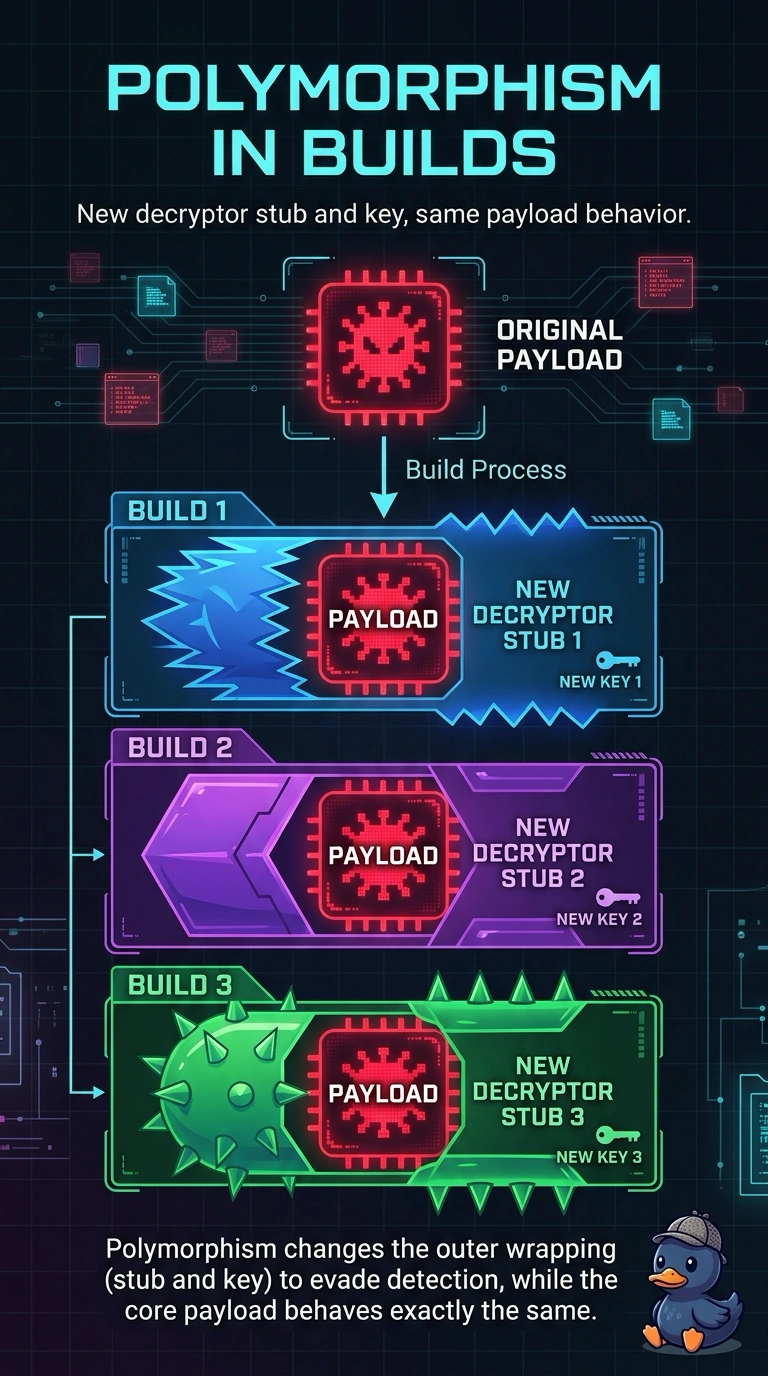
Two malware builds used against a software company show the same payload behavior, but each build ships a different decryptor stub and a different key. What property do those builds demonstrate?
Select an answer to reveal the explanation.
Short Explanation
Picture the same letter in a new envelope with a new lock, while the message stays put. You are looking at polymorphism: the stub and the key changed, and the payload behavior did not. A rewrite of the instruction body would be a different property, and a plain encoding pass would not need a fresh key.
Full Explanation
Polymorphic malware changes a wrapper or key and keeps the same behavior. The shared behavior is the point of the comparison, not a shared file hash of the wrapped sample. These builds show polymorphism, meaning a new decryptor stub and key around payload behavior that stays the same. Metamorphism, meaning a rewrite of the instruction body so little of the prior code remains, is the other property: the body itself would change, which is not what these two builds show. A one-way hash of the payload would prevent recovery of the original instruction bytes, but a decryptor stub and key exist so the payload can be recovered and run, which is the opposite of a hash. Plain encoding that stores one identical decryptor stub as hexadecimal text would not produce a different stub and a different key on each build. Exam caveat: after the stub runs, the decrypted behavior can match even when the on-disk bytes do not, so hash the payload and the stub separately. Operational check: in a lab, note that the stubs and keys differ, then compare the decrypted behavior or the decoded payload bytes for a match.