
A SOC analyst finds a PowerShell -enc blob that decodes with a standard base64 routine and no key. Is this encryption or encoding, and what can the analyst do immediately?
Select an answer to reveal the explanation.
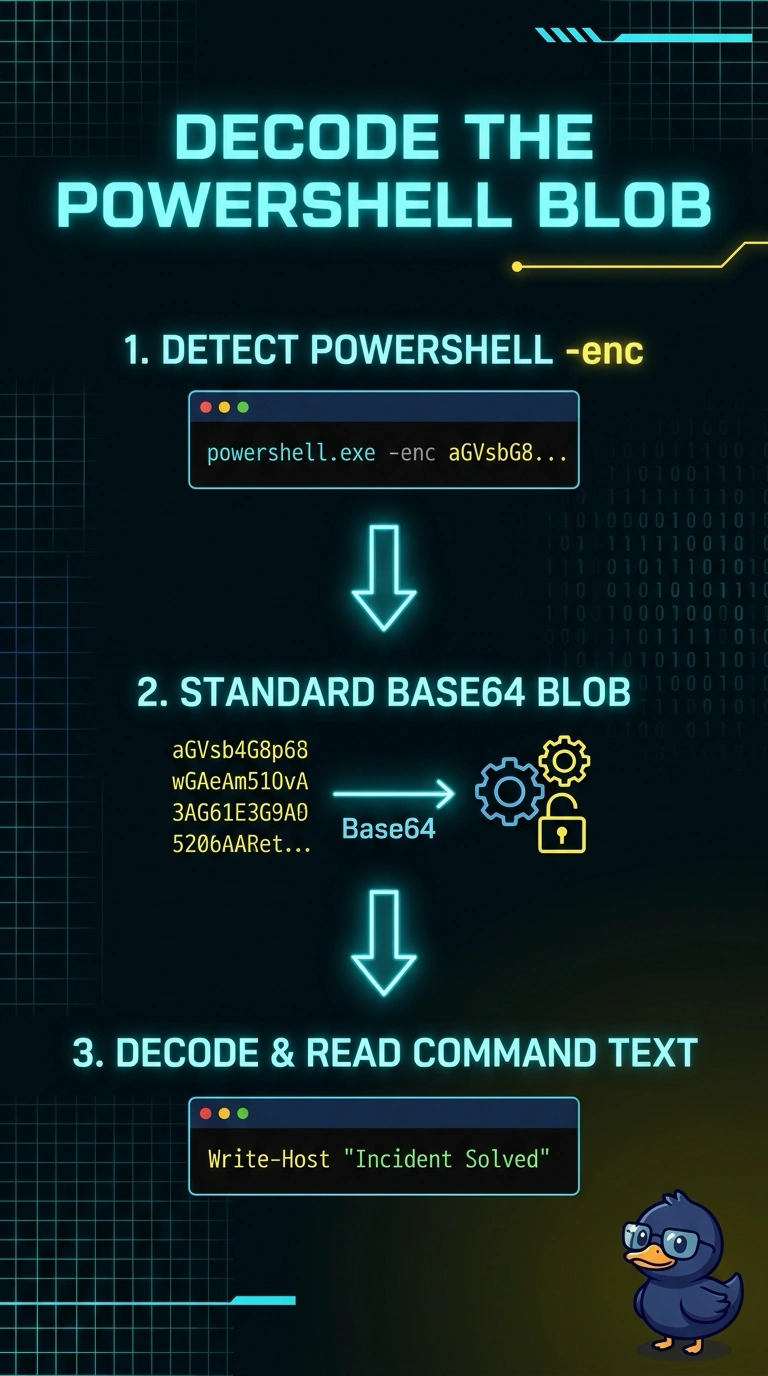
Short Explanation
Base64 is a costume, not a lock on the trunk. You can decode this PowerShell blob with a standard base64 routine and no key, then read the command, because it is encoding. Do not wait for a recovered secret, brute-force a password, or treat a base64 routine as if it needed one.
Full Explanation
The -enc blob is base64 encoding, not encryption. No key is involved, so the analyst can decode the blob now and read the resulting command text. Analysts sometimes treat the blob as a cipher because it looks opaque, yet a standard decoder produces the command without a secret, a wordlist, or a password vault. After decoding, interpret the bytes as Unicode text so the command reads as script rather than spaced characters, and keep that text as the indicator. It is not encryption, and the blob does not stay unreadable until a secret key is recovered from the host. It is not encryption that requires a long secret to be brute-forced before any command text is readable; brute force is for a cipher with a key, and this routine has none. It is encoding, and a password is not still required before the base64 routine returns the text. Exam caveat: the decoded bytes are the command text in a Unicode encoding, so a plain character view can look spaced until you interpret the text, and that step is still not decryption. Operational check: decode the blob with a base64 decoder, interpret the bytes as Unicode text, and record the command without executing it.