
A school SOC uses one YARA rule to tag a malware family across a case and records the sample hash in the meta section. Beyond a block, what job is that rule doing?
Select an answer to reveal the explanation.
Short Explanation
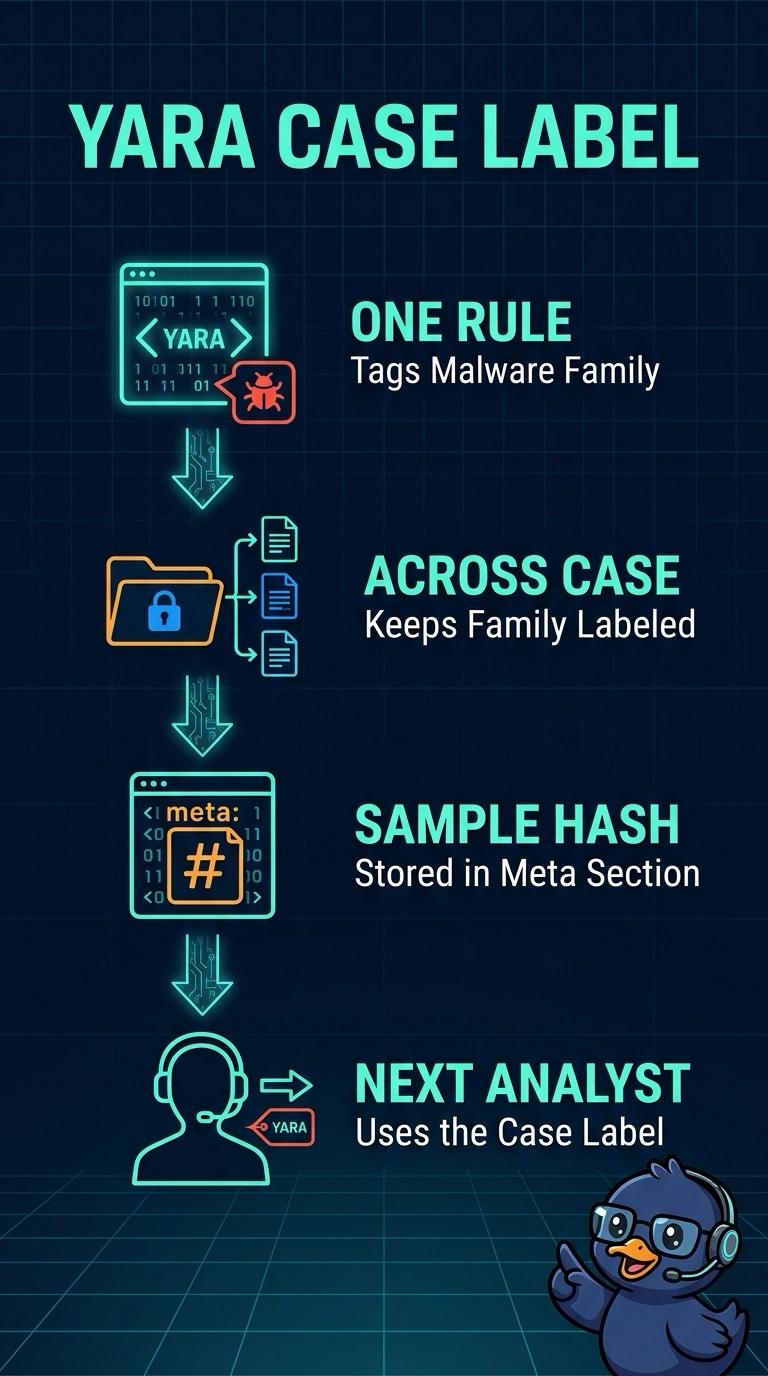
Think of the rule as a name tag on the family, not as a lock on the door. You are labeling the case and the meta section stores the sample hash so the next analyst can see which file the tag came from. The trap is reading that rule as a firewall packet drop or as a decryptor.
Full Explanation
YARA is often used to classify and document, not only to feed a blocking control. Here one rule tags a family across the case, and the meta section stores the sample hash as a case label the next analyst can read. A firewall block list that drops packets when the rule file is loaded is a different control; the rule file sitting on disk does not itself become a packet filter. A decryptor that recovers plaintext from the hash stored in the meta section misunderstands both hashing and meta, which do not reconstruct file contents. A network detector that alerts when the sample hash appears in a flow record is chasing a hash through flow telemetry. Storing a hash in YARA meta does not create a network detector or compare that value with telemetry; matching is controlled by the rule strings and condition. The job in front of you is the case label and the stored sample hash, which let later readers tie the rule to the file they are studying. A later block, if some control can consume a hash or a pattern, is a separate step from the labeling this rule is doing inside the case. Exam caveat: meta is carried with the rule for people, while strings and the condition decide which files match. Operational check: open the rule, confirm the meta hash matches the sample in the case, and confirm the same rule is how the team tags that family.