
A factory incident script stores a command as hexadecimal text that base64-decodes into the command the attacker runs. Why is that nested encoding still not encryption?
Select an answer to reveal the explanation.
Short Explanation
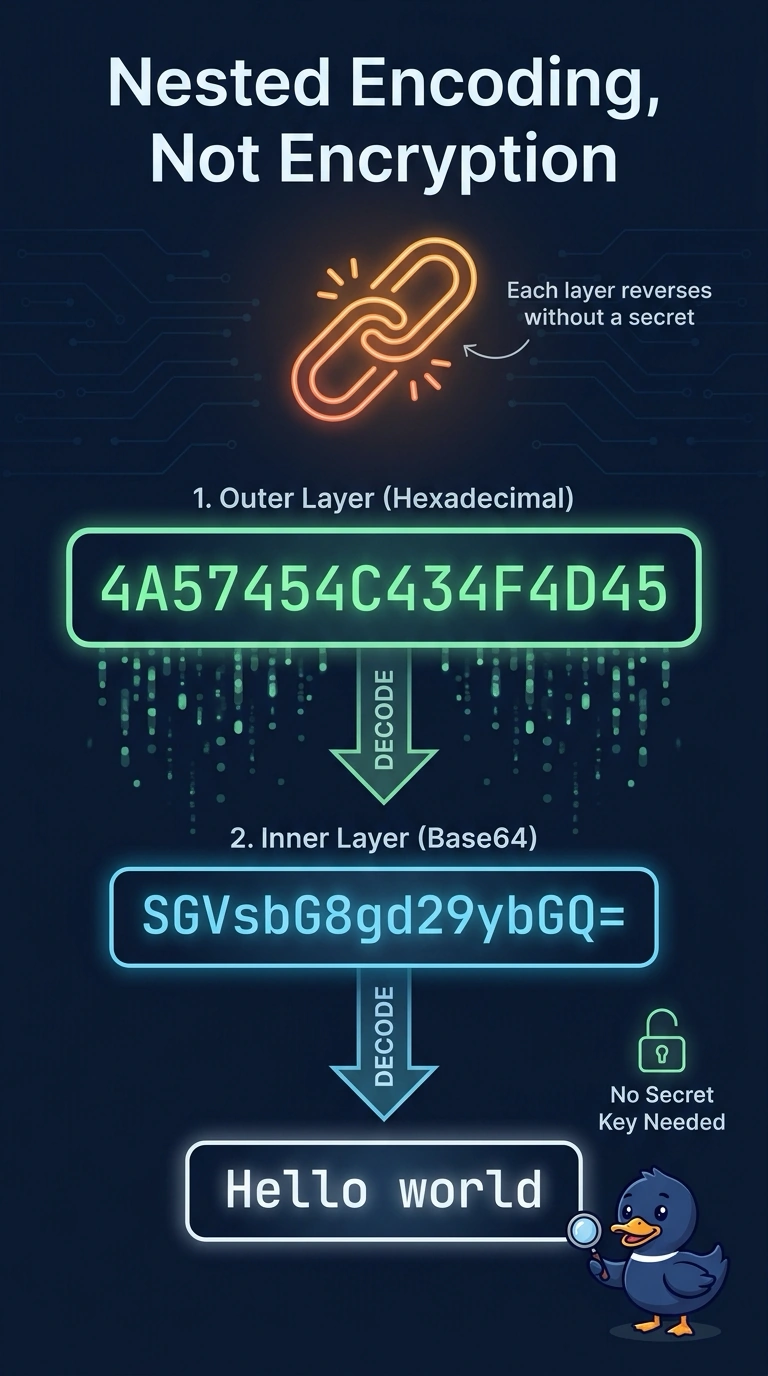
Stacking hexadecimal and base64 is two costume changes, and you can walk both of them backward with no key. The nested result is still encoding, because neither layer asks for a secret. It does not turn into encryption just because a second alphabet showed up.
Full Explanation
Hexadecimal encoding and base64 are both public transforms. A real cipher fails closed until its key is supplied, and neither of these layers fails closed. Each layer reverses without a secret, so the nested hexadecimal and base64 stack remains encoding, and the command appears once both layers are undone. The inner layer does not turn into encryption as soon as two different encodings have been stacked together; adding a second encoding does not introduce a key. The hexadecimal text is not itself encryption, and the base64 text is not an outer wrapper around a secret; both layers are alphabets, not ciphers. The nested stack cannot be described as reversible only when the analyst possesses the malware author's private key, because no private key participates in either decode. Exam caveat: nested encoding can hide a further encrypted blob, and if a real cipher appears you will need its key, but these two layers are not that cipher. Operational check: reverse the hex text and then base64-decode in a lab editor, do not execute the result, and confirm the command appears with no key entered.