
An analyst will not reverse a base64 blob found in a script, arguing that a secret key is required before the original bytes can come back. What distinction corrects that claim?
Select an answer to reveal the explanation.
Short Explanation
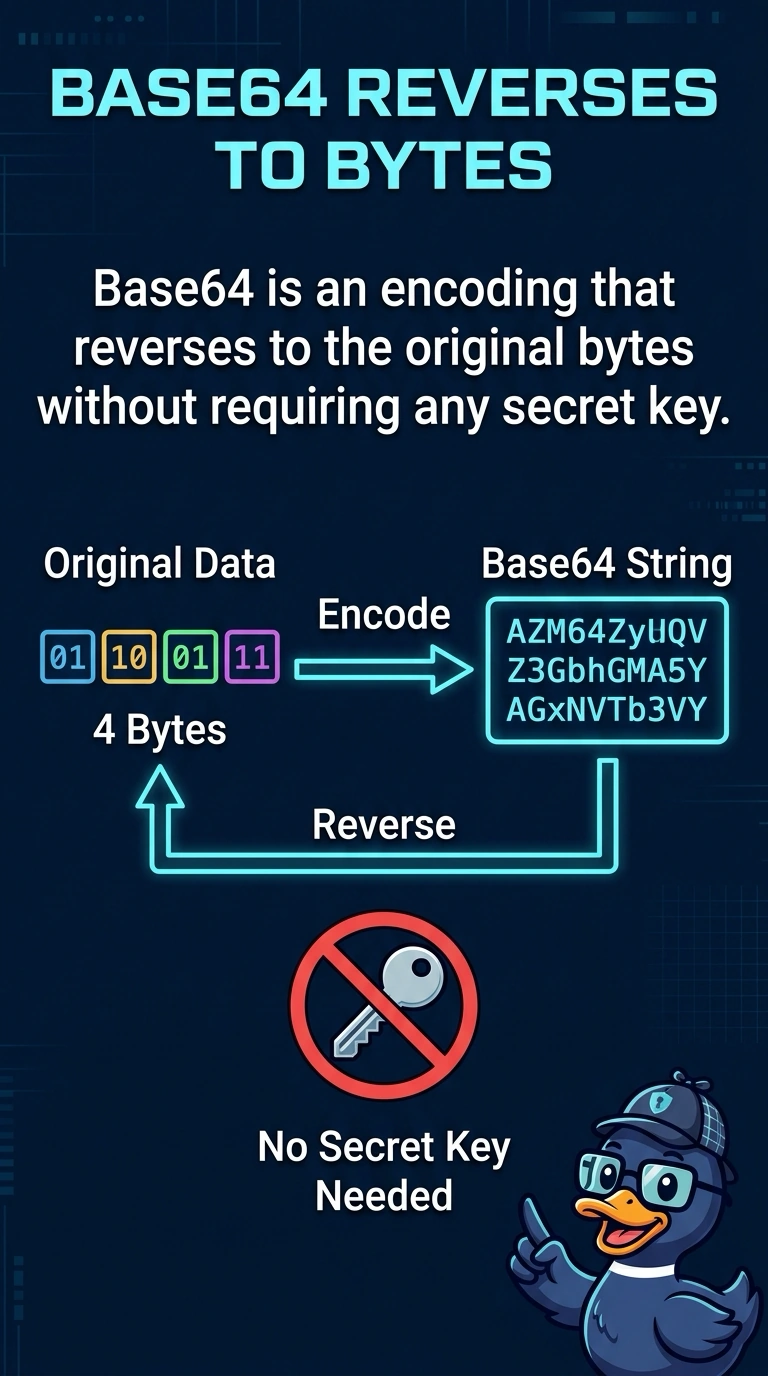
Base64 is a costume change, not a locked box. You can turn the blob back into the original bytes with no secret at all, which is what encoding means. A hash would not hand the bytes back, and a packer is the wrong story for a plain alphabet.
Full Explanation
Base64 maps bytes to a text alphabet with a published rule, and the reverse map needs no secret. Treating that alphabet as a cipher sends the analyst hunting for key material the transform never used, and it delays a decode a text editor can finish. Base64 is an encoding that reverses to the original bytes without requiring any secret key, so the analyst can decode the blob directly. It is not encryption, and the blob does not stay unreadable until a matching secret key is found; encryption is what requires the key. It is not a one-way hash, and the original bytes can be recovered from the blob, which is the difference between an encoding and a hash. It is not a packer, and the blob does not need to be executed in a lab before the original bytes return; decoding is a static text transform. Exam caveat: attackers stack encodings to frustrate a casual reader, but stacking base64 still does not create a key. Operational check: base64-decode the blob in a lab editor, do not run it, and confirm readable content or a further layer appears with no key supplied.