
Patient files on a nursing-station workstation cannot be carved, and a wiping utility ran before shutdown. A verified overwrite of the original allocated sectors completed on a conventional magnetic disk. How does that differ from dropping the same files in the Recycle Bin?
Select an answer to reveal the explanation.
Short Explanation
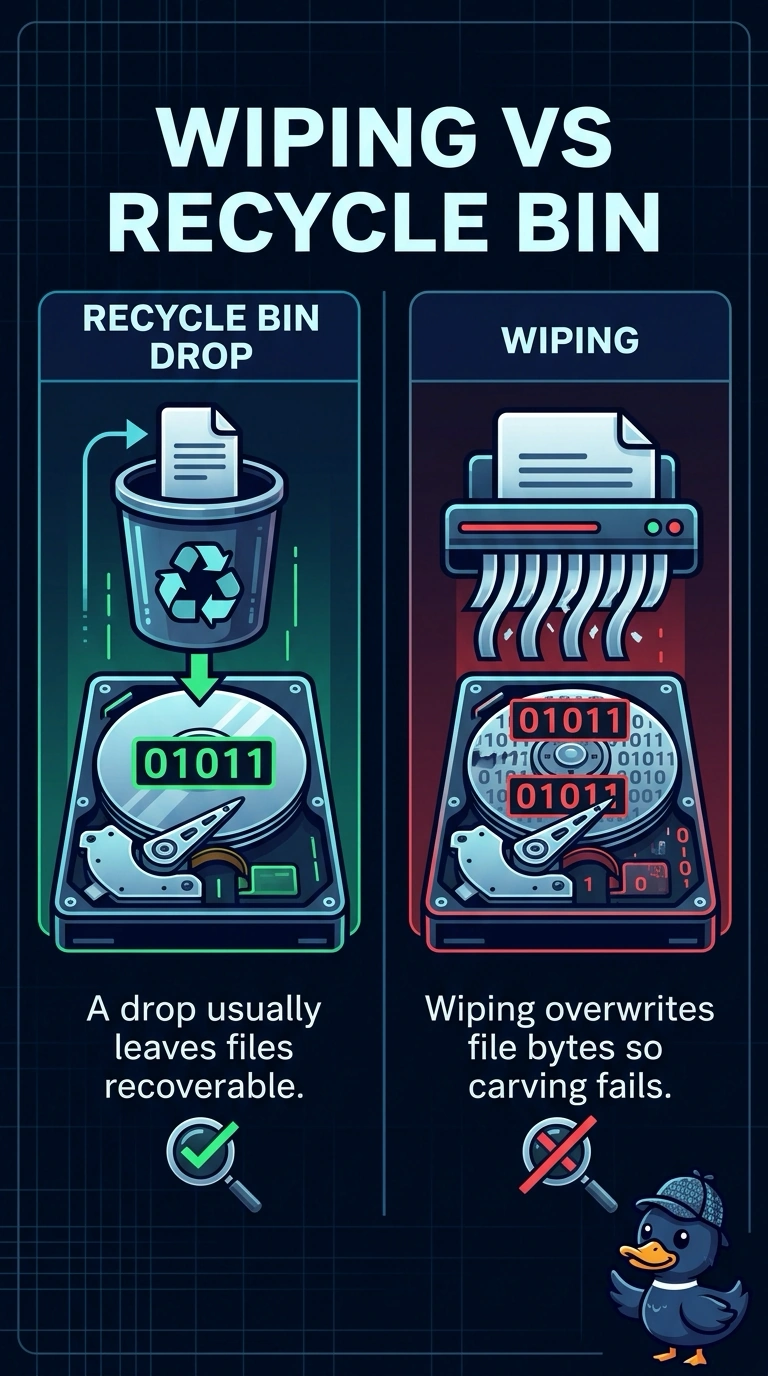
You can see the difference when you compare methods: A verified overwrite of the original allocated sectors completed on a conventional magnetic disk. Moving a file to the Recycle Bin normally retains its live contents; permanent deletion or emptying the Bin can later free the allocation. Neither operation by itself is the verified sector overwrite described here.
Full Explanation
A verified overwrite of the original allocated sectors completed on a conventional magnetic disk. That stipulated method is why carving fails for those patient files, because overwrite replaces the allocated bytes rather than merely unlinking a directory entry, leaving no original contents to reconstruct. Moving a file to the Recycle Bin normally retains its live contents; permanent deletion or emptying the Bin can later free the allocation. Neither operation by itself is the verified sector overwrite described here. The claim that wiping only renames is wrong by concept because a rename preserves data clusters while the stipulated overwrite destroys them, so rename cannot explain unrecoverability. The claim that wiping copies to a cloud snapshot is wrong because local sector overwrite does not create provider-side copies, and the clinic cannot image hypervisor storage to undo a local wipe. The claim that wiping encrypts filenames with a key in the master file table is wrong because encryption would leave ciphertext and key material that might still be carved, while overwrite aims to remove contents. A tool run plus failed carving alone would not prove success on SSD or copy-on-write storage, which is why the stem stipulates verified overwrite on magnetic disk.