
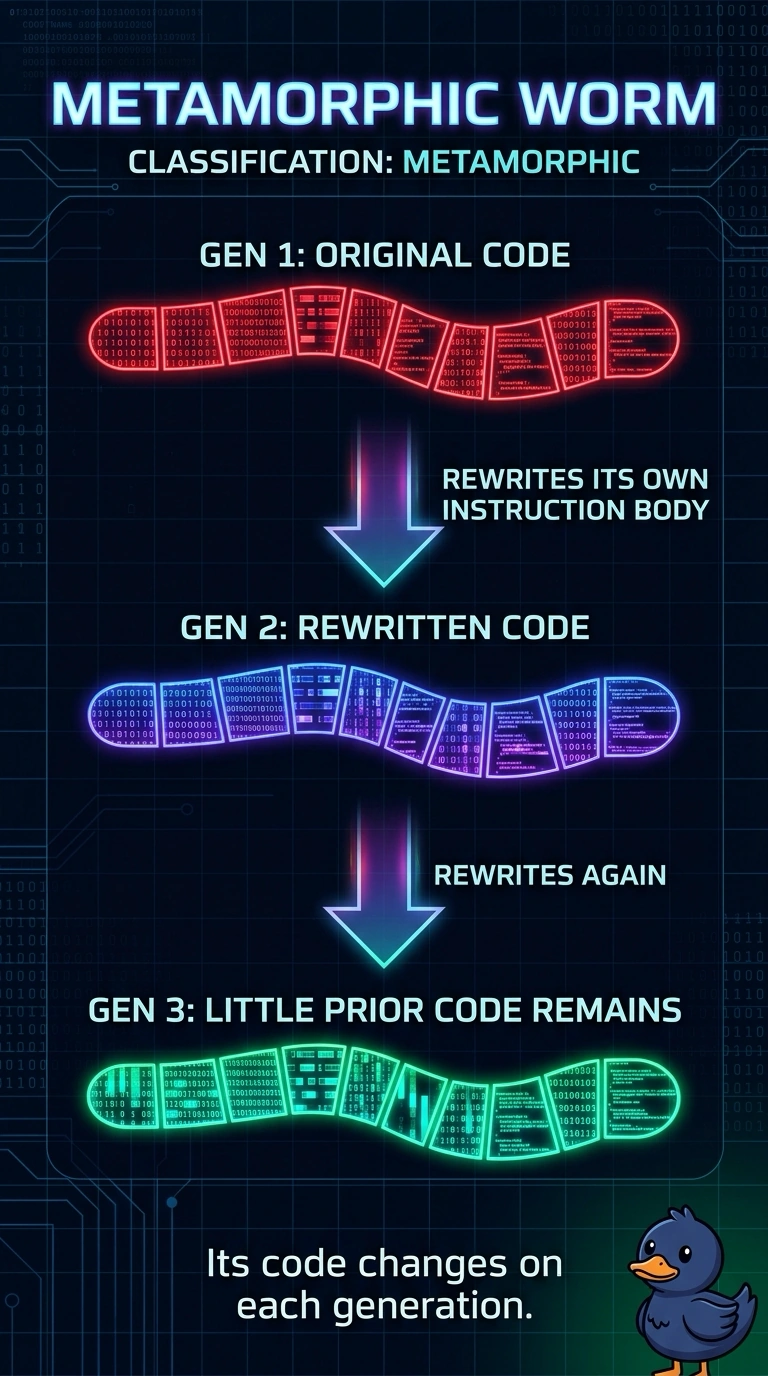
Each new generation of a worm on a factory network rewrites its own instruction body until little of the prior code remains. How does that behavior differ from a polymorphic packer?
Select an answer to reveal the explanation.
Short Explanation
A polymorphic packer changes the envelope. This worm rewrites the letter until the old handwriting is gone, so you are looking at metamorphic code, not a stub swap. A base64 costume or a renamed file with the same bytes is a different trick.
Full Explanation
Metamorphic malware rewrites its own body so later generations share little code with earlier ones. This worm is metamorphic and rewrites its own instruction body on each new generation, which is more than a wrapper change. It does not match a polymorphic packer that only swaps a decryptor stub while the body stays intact; a polymorphic packer changes the wrapper or key and keeps the behavior, and the decrypted body can still match. It is not a base64 encoding pass that stores an identical instruction body as readable text, because an encoding does not rewrite instructions and the body here does not stay identical. It is not a hex-editor filename change that leaves the original instruction bytes fully intact, because the scenario says the instruction body itself is rewritten. Exam caveat: polymorphic samples can look unrelated on disk and still share a decrypted body, while metamorphic samples keep little of that prior code. Operational check: compare two generations in a disassembler and see whether the instruction body changed, not only the stub or the file name.