
A hospital privacy analyst recovers a stolen payroll spreadsheet only as an encrypted archive, and the employee does not recognize the password. What anti-forensic problem does that archive create for the review?
Select an answer to reveal the explanation.
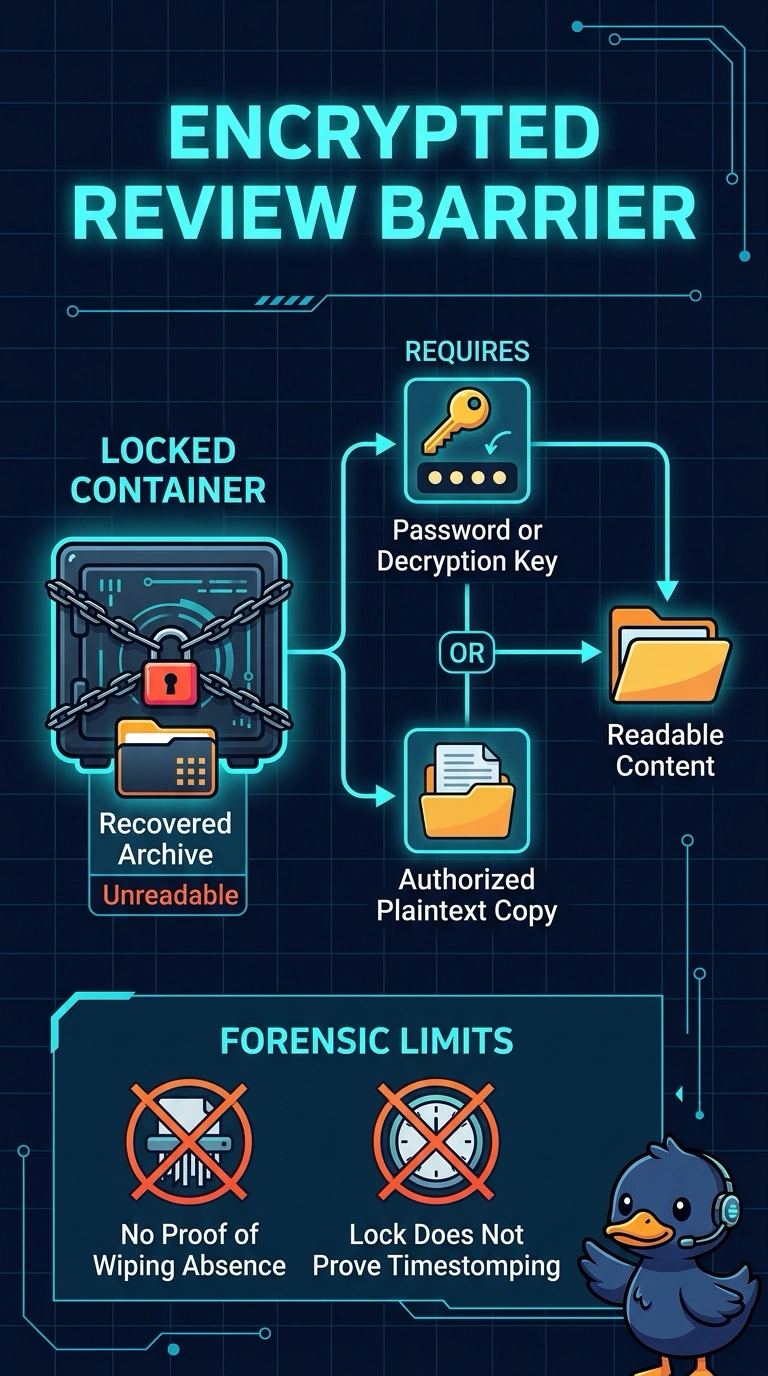
Short Explanation
Think of a locked briefcase you have in hand — you still need a key or another trusted copy to read the papers inside. You face a review barrier until a recovered password, decryption key, or authorized plaintext copy lets you inspect the rows, and the locked container alone tells you nothing about other copies or wiping.
Full Explanation
Encryption is the barrier in front of the reviewer: Review of the encrypted content requires a recovered password/decryption key or an authorized plaintext copy, so the payroll rows stay unreadable even though the container was recovered. Recovering an encrypted archive neither proves nor excludes secure deletion of its plaintext original, and does not establish whether a plaintext copy previously existed on this endpoint. Unknown credentials alone do not demonstrate timestomping. A claim that the archive proves a secure-deletion tool already wiped the spreadsheet mistakes a locked container for proof of wiping, when wiping concerns unrecoverable deletion of original bytes. An idea that the unknown password shows timestamp tampering confuses access control with time metadata falsification, which would still leave content that opens while only altering dates. A reading that the encrypted archive shows absence from the endpoint reverses the finding, because the wrapped spreadsheet was recovered there even if other plaintext copies remain unknown. Exam caveat: focus on the review barrier actually present and do not infer deletion, timestomping, or absence from locked credentials alone. Operational check: hash the archive, record its path, and ask the password-vault owners whether any approved secret or authorized copy opens it before you describe the payroll rows.