
An attacker held privileged EXEC access on the edge router during the intrusion. Why are that router's own logs not sufficient by themselves?
Select an answer to reveal the explanation.
Short Explanation
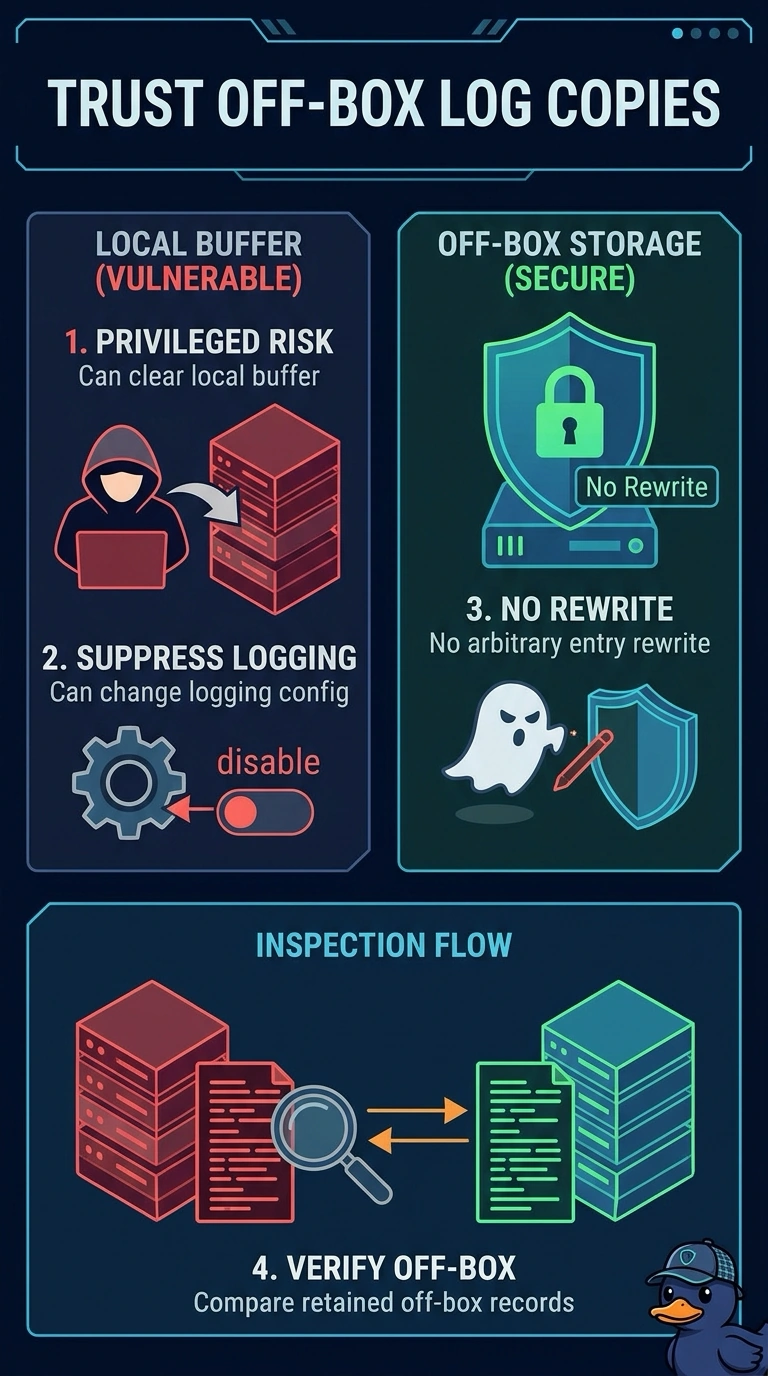
A diary the burglar was allowed to clear is a poor record of the burglary. Privileged access can clear the local logging buffer or change logging configuration; this does not imply a supported command for rewriting arbitrary individual buffer entries. So you compare retained off-box records because the startup configuration and a banner photo do not replace that copy.
Full Explanation
Privileged EXEC access is enough to change logging, clear the buffer, or alter what the router will say about itself. Privileged access can clear the local logging buffer or change logging configuration; this does not imply a supported command for rewriting arbitrary individual buffer entries. The attacker can clear or suppress local logging, so compare retained off-box records before you trust the on-box story. The claim that the on-box buffer is already a complete attack history fails because clearing or suppressing leaves gaps. The startup configuration retains the saved configuration, not an uneditable copy of every log line from the attack window. A photograph of the router banner is a picture of a login message, and it is not enough to reconstruct every command from the intrusion. Treat the router as a device the attacker could administer, pull the syslog collector and the accounting server for the same period, and describe any stretch where both independent copies are missing. Exam caveat: if syslog and accounting were only local, you may have no independent copy, and you say that gap plainly. Operational check: compare the on-box buffer with the syslog collector and the AAA accounting server for the same window.