
Someone added a static route on a branch router during an incident, and AAA command accounting is enabled. Which record identifies the account that entered the command?
Select an answer to reveal the explanation.
Short Explanation
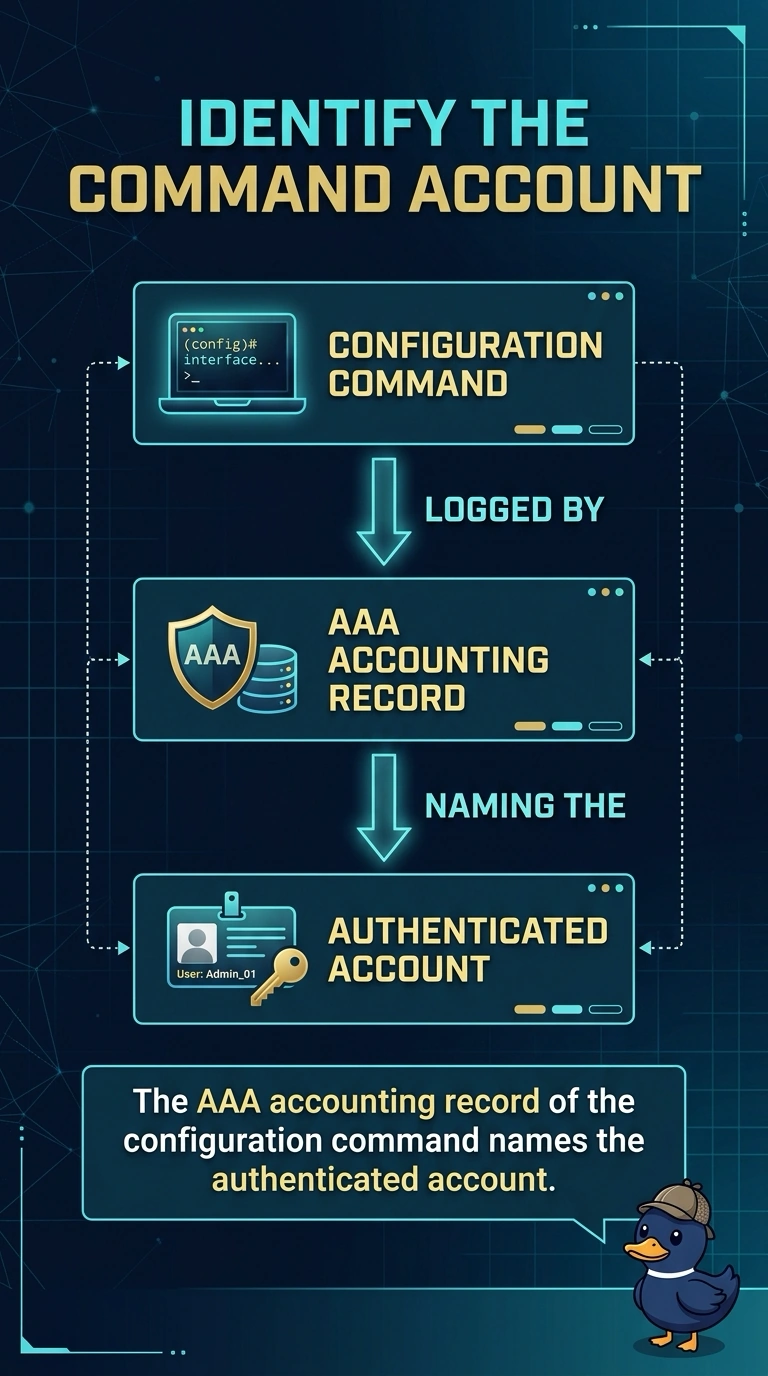
The signature line on a change form is what tells you who approved the edit, not the sticker on the door. You want the AAA accounting record of the configuration command, because that names the authenticated account. The address table, the banner, and neighbor discovery do not store that signature.
Full Explanation
AAA command accounting records configuration commands along with the authenticated account that entered them, so the accounting record of the static-route command is the one that identifies who added it. The MAC address table maps addresses to ports, and treating it as the store of the admin username that added the route invents a field the table does not have. The login banner text is a message shown at login, not a historical log of who added the static route. The neighbor discovery table lists adjacent devices, and treating it as a field that carries the configuring account name confuses topology with accounting. Match the command text in the accounting entry to the static route you found, keep the account name beside the timestamp, and do not substitute a banner, a MAC table, or a neighbor list for that accounting line. Exam caveat: accounting must have been enabled before the change, or the AAA server will have no line for it. Operational check: on the AAA server, find the accounting entry for that route command and read the account name and timestamp.