
A branch-office capture shows bytes that look like an HTTP request line and headers, sent to a high port that is not a usual web port. What is odd about this traffic if nobody decrypted it?
Select an answer to reveal the explanation.
Short Explanation
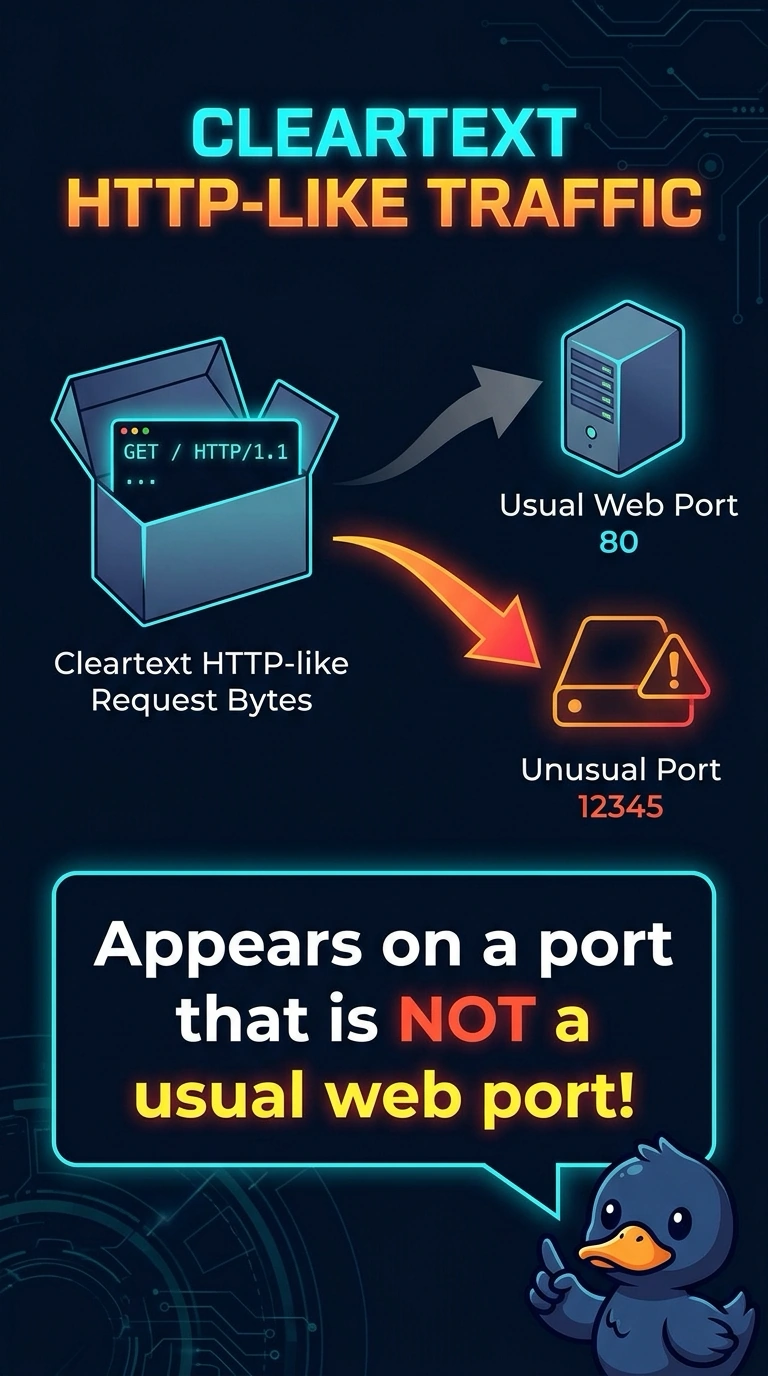
You can read the postcard, so nobody had to steam open a sealed envelope. Cleartext HTTP-like request bytes appear on a port that is not a usual web port, and that mismatch is the odd part. Do not upgrade a visible request into a story about decryption or a finished exploit.
Full Explanation
The capture already shows request bytes that look like HTTP, so the odd fact is that this cleartext appears on a port that is not a usual web port. Nobody needs to claim a sensor decrypted the session or recovered hidden command text, because the bytes were readable without that step. A high port does not by itself show a fragmented scan rather than an application request; the payload looks like a request, not like a sweep of ports. A visible request line does not prove a remote exploit already executed on the server, any more than a logged request proves the payload ran. The finding stops at protocol-looking cleartext on an unexpected port until more of the exchange is read. If the bytes had been encrypted, that request line would not be sitting in the clear for anyone to quote. The case note is the port beside the readable request, documenting an application where operators do not usually expect it, without a claim that a cipher was broken or that code ran. Exam caveat: seeing HTTP-like bytes is not the same as proving the far end ran attacker code. Operational check: follow the stream for that high port, read the request line, and write down that the text was visible without a decryption step.