
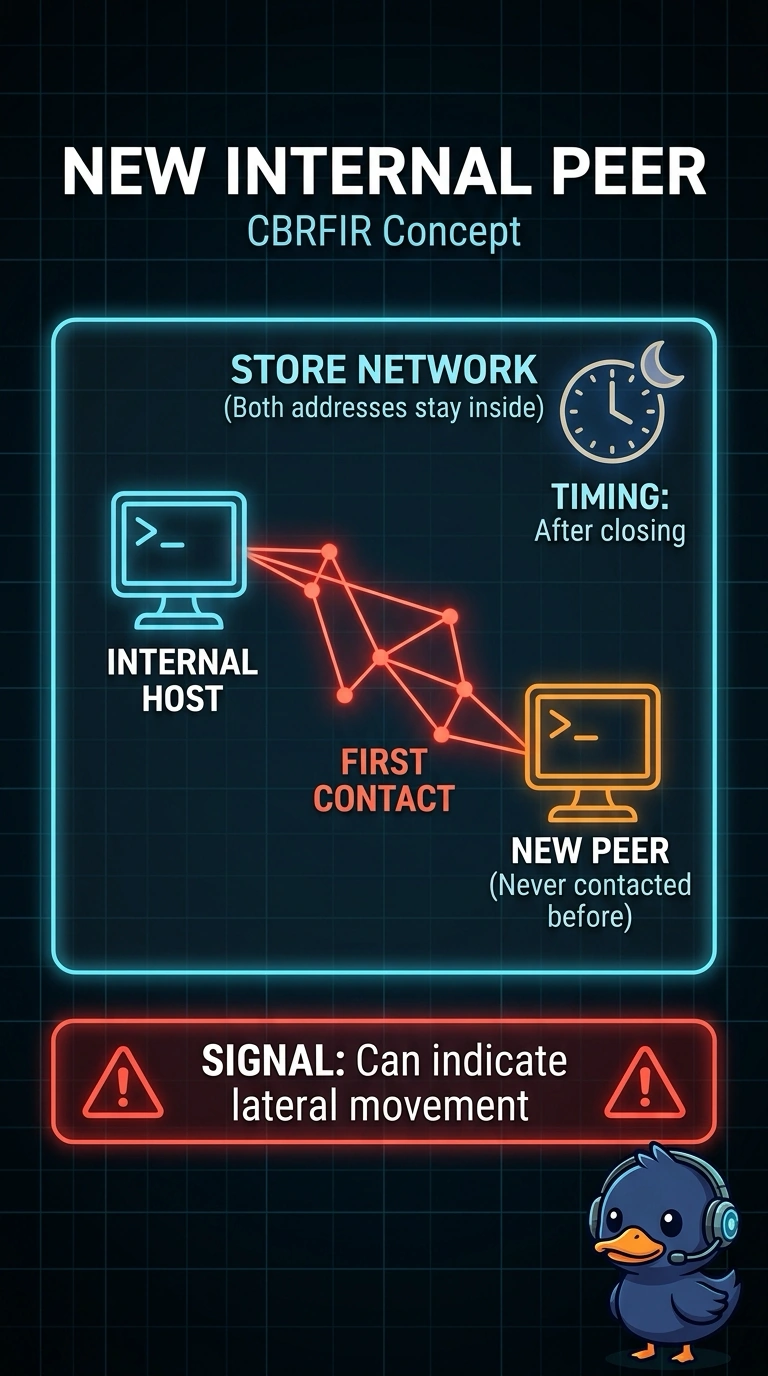
After closing, a grocery payment register starts a session with an internal host it has not contacted before. Why is that new peer an indicator even though both addresses are internal?
Select an answer to reveal the explanation.
Short Explanation
Two coworkers in the same store can still be up to something on a shift they have not shared before. You should treat a new internal peer after hours as possible lateral movement even when both addresses stay inside. Do not drop the finding because the register stayed off the public Internet, and do not claim the card data already left.
Full Explanation
Private addressing is not a free pass. Internal addresses do not cancel the finding, and a new peer inside the store is not expected traffic merely because both ends sit on the store network. The register is not beaconing toward the public Internet, so that external path is not the concern this session describes. The session by itself proves nothing about card data already leaving the store for an outside collector; theft of payment data is a hypothesis, not a fact established by one new pair. A new internal peer can still be lateral movement when both addresses stay inside the store, especially after hours on a register with a small set of normal partners. Attackers often move between internal hosts so the activity never has to cross the edge at all. A register that suddenly peers with a new internal admin host, a jump box, or a file share is the sort of pair worth a ticket even though no public address appears. Exam caveat: a new internal pair is a reason to investigate, and it is not proof of what, if anything, was copied. Operational check: compare the register's recent peers with its baseline and confirm this internal host was not a normal partner during open hours.