
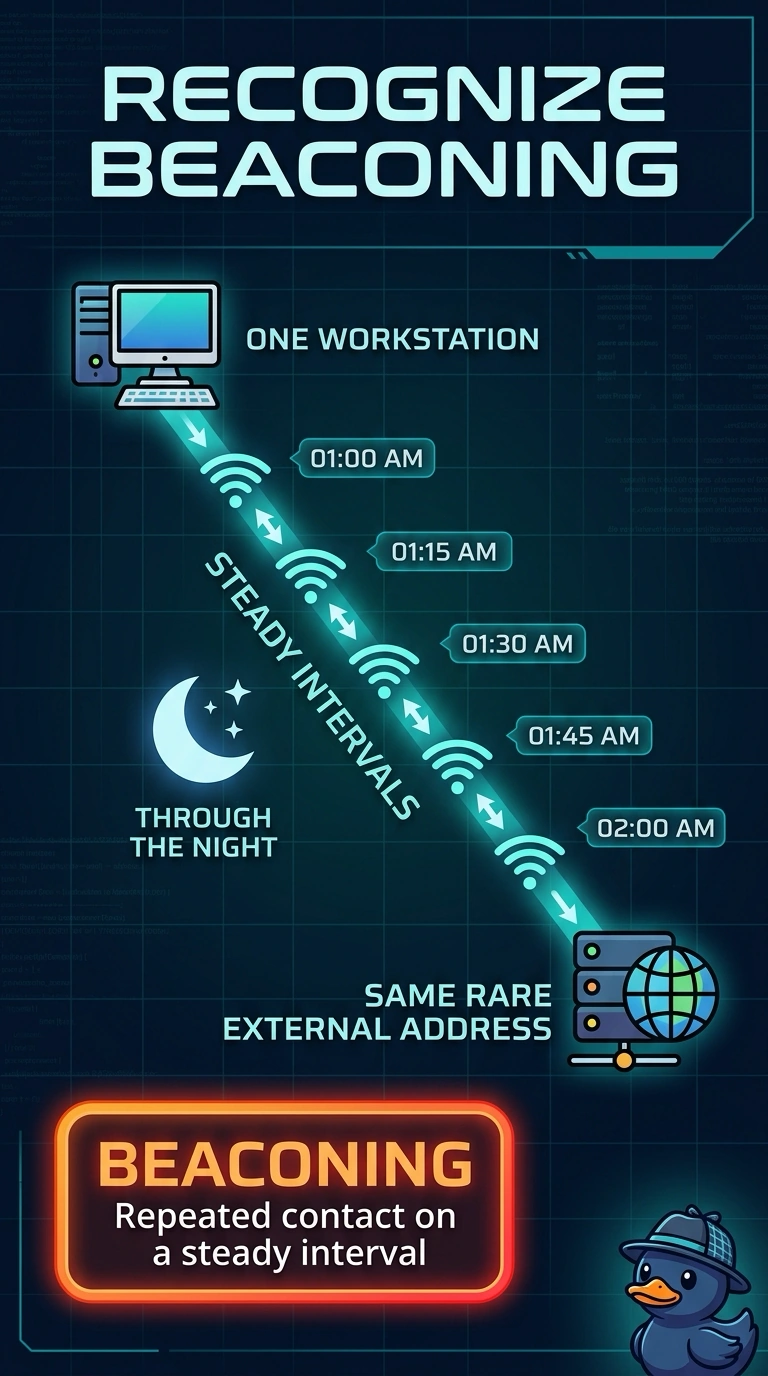
One workstation at a clinic calls the same rare external address on a steady interval through the night. Which anomaly do those flows show?
Select an answer to reveal the explanation.
Short Explanation
A night light blinking on one schedule is a beacon, not a tour of the neighborhood. You are looking at repeated calls to the same rare external address all night. A scan would knock on many doors, and a single big transfer would not keep that steady rhythm.
Full Explanation
Beaconing is repeated contact from one host to a destination on a regular cadence, often toward a rare external address the host does not use for ordinary work. These flows are beaconing, seen as repeated contact with one rare external address on a steady interval through the night, which is the callback pattern associated with a quiet implant or a scripted agent. A horizontal scan contacting many internal addresses on one service port would fan out across the clinic network; this pattern stays on one external address. DNS tunneling that hides data in long labels and unusual types toward one domain is a query-shape problem, and these flows are described as calls to an address, not as odd DNS questions. A one-time bulk transfer moving a large volume of data toward many new peers is a single heavy push with new destinations, not an all-night interval to one peer. Exam caveat: a vendor update can also call out on a schedule, so rarity of the address and the host's role still matter before you call it malware. Operational check: plot the connection timestamps to that address and confirm the interval repeats, then compare the destination with the host's normal external peers.