
A school district's web-tier access log has every surrounding hour but nothing for the suspected attack hour. How should analysts treat that gap?
Select an answer to reveal the explanation.
Short Explanation
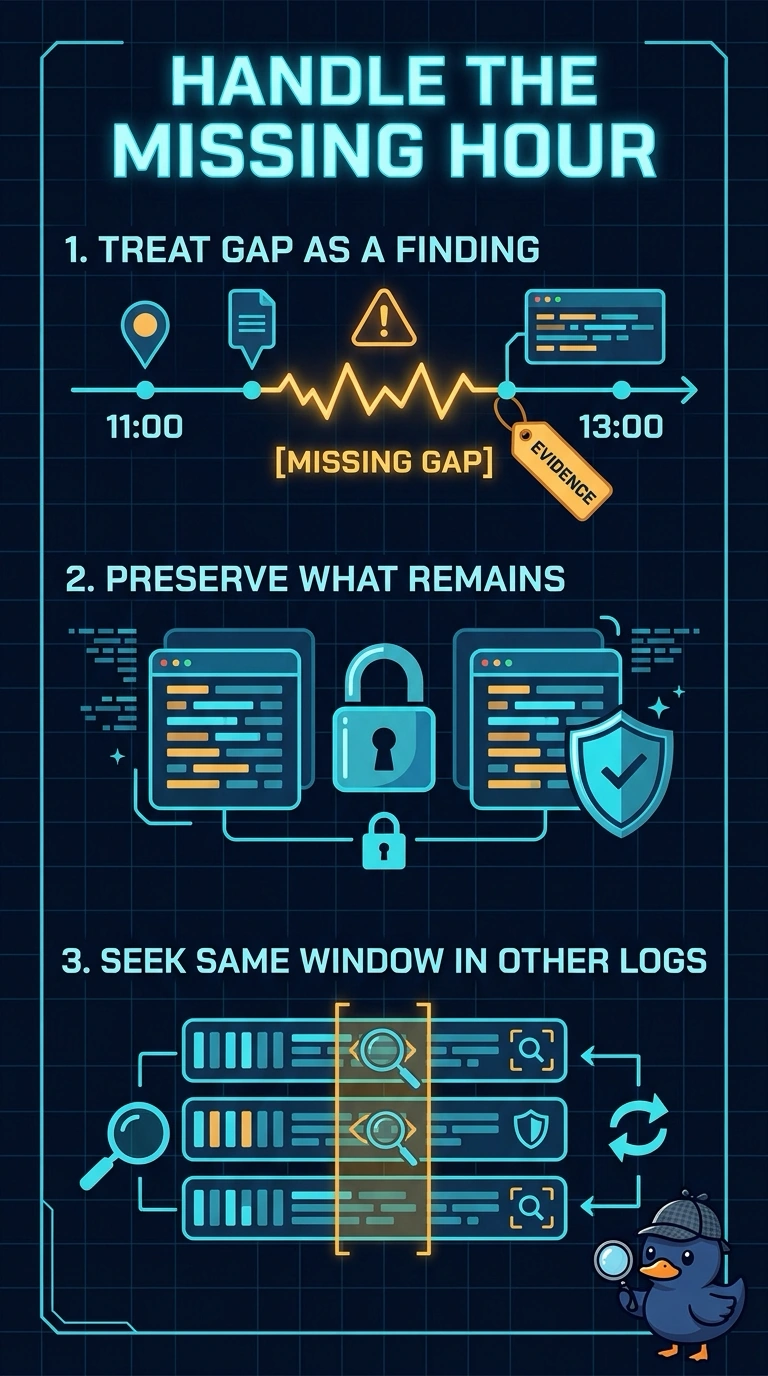
A missing page in a logbook is not a quiet hour. You treat the absent attack hour as its own finding, keep the lines you still have, and look for that hour somewhere else. Inventing the lines, or assuming nothing arrived, hides the story.
Full Explanation
A gap where an access log should exist is itself evidence to explain: rotation, a collector failure, or someone removing the hour. Analysts should treat the missing hour as a finding, preserve the hours that remain, and seek that same window in other retained logs such as the load balancer, a central syslog copy, or a neighboring tier. Reading the empty hour as proof that no client requests arrived during the attack confuses absence of a record with absence of activity; the surrounding hours show the log was otherwise writing. Rebuilding the missing lines from memory so the access log looks continuous fabricates content and damages the file as evidence. Removing the surrounding hours so the file no longer shows an obvious gap destroys the context that makes the gap visible and is an anti-forensic instinct, not an analysis step. Exam caveat: a gap can be benign log rotation, so document the collection path before you call it tampering. Operational check: compare filenames and timestamps for that host's access logs and query any off-box copy for the same hour before you close the timeline.