
A hotel booking portal logged this search value, including the leading quote: ' UNION SELECT card, pin FROM vault. How should an analyst classify that snippet?
Select an answer to reveal the explanation.
Short Explanation
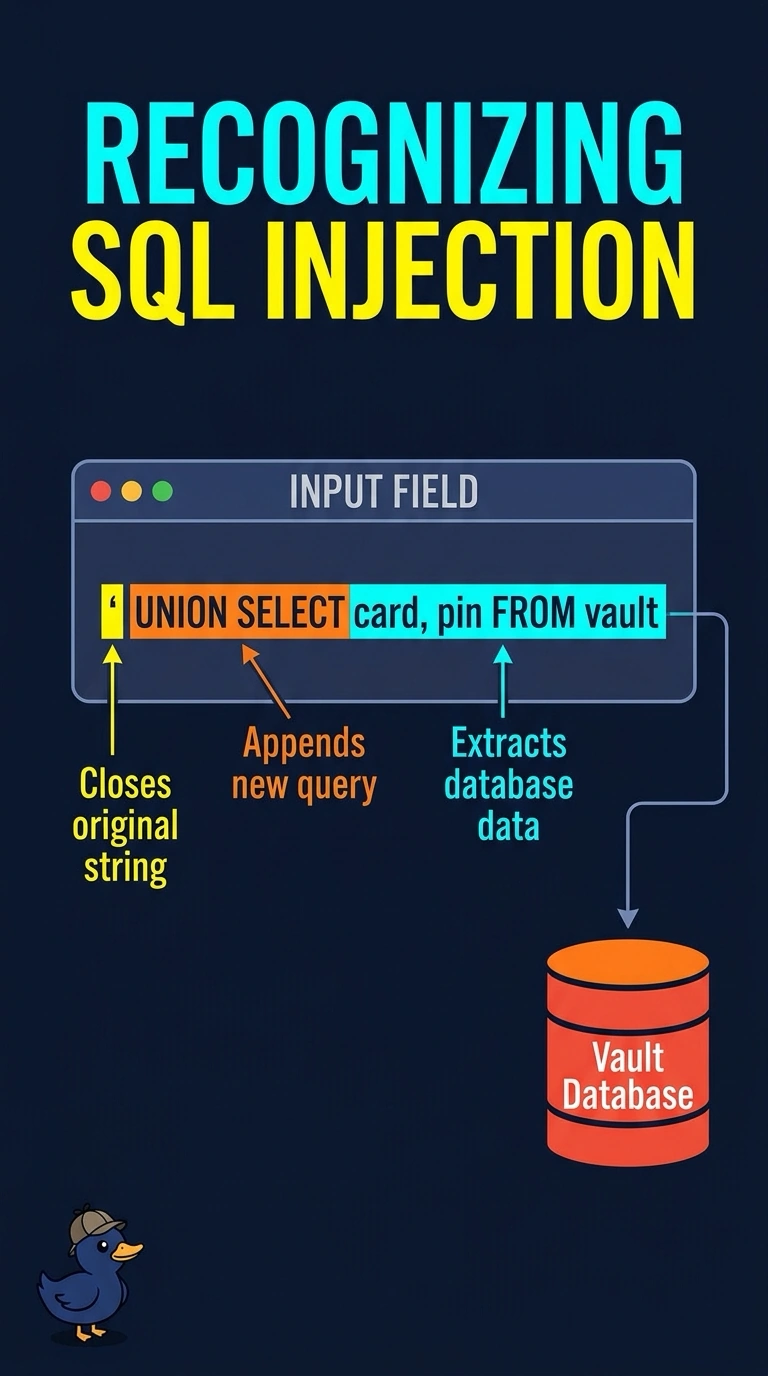
You caught the classic trick here — that leading quote is trying to break out of the app's string. You're looking at SQL injection where UNION adds a branch to the original query to combine in card and pin rows, not a shell pipeline, PowerShell filter, or YARA rule.
Full Explanation
The snippet is SQL injection that closes a string with a quote and appends a UNION SELECT query. The leading quote is an attempted string termination whose success depends on the surrounding SQL, and UNION adds a SELECT branch to the original statement and combines compatible result rows into the query result; it is not a separately stacked SQL statement, with card and pin from vault as fields inside the injected branch. A Bash pipeline that feeds UNION into SELECT as two stages of one shell command would require a pipe character between processes, which this log line does not contain and the database would not execute as shell. A PowerShell filter that projects card and pin columns from an object pipeline would look like Select-Object or similar cmdlet syntax, not a quoted web parameter containing SQL keywords. A YARA condition that matches the words UNION and SELECT inside a scanned file is a file-matching rule for malware triage, not a query the database might execute. Exam caveat: the portal log proves the text arrived in the request, not that the database accepted the union or returned rows. Operational check: compare the application or database error around that timestamp for a syntax failure versus combined compatible result rows in the query result before you treat the log line as a completed theft.