
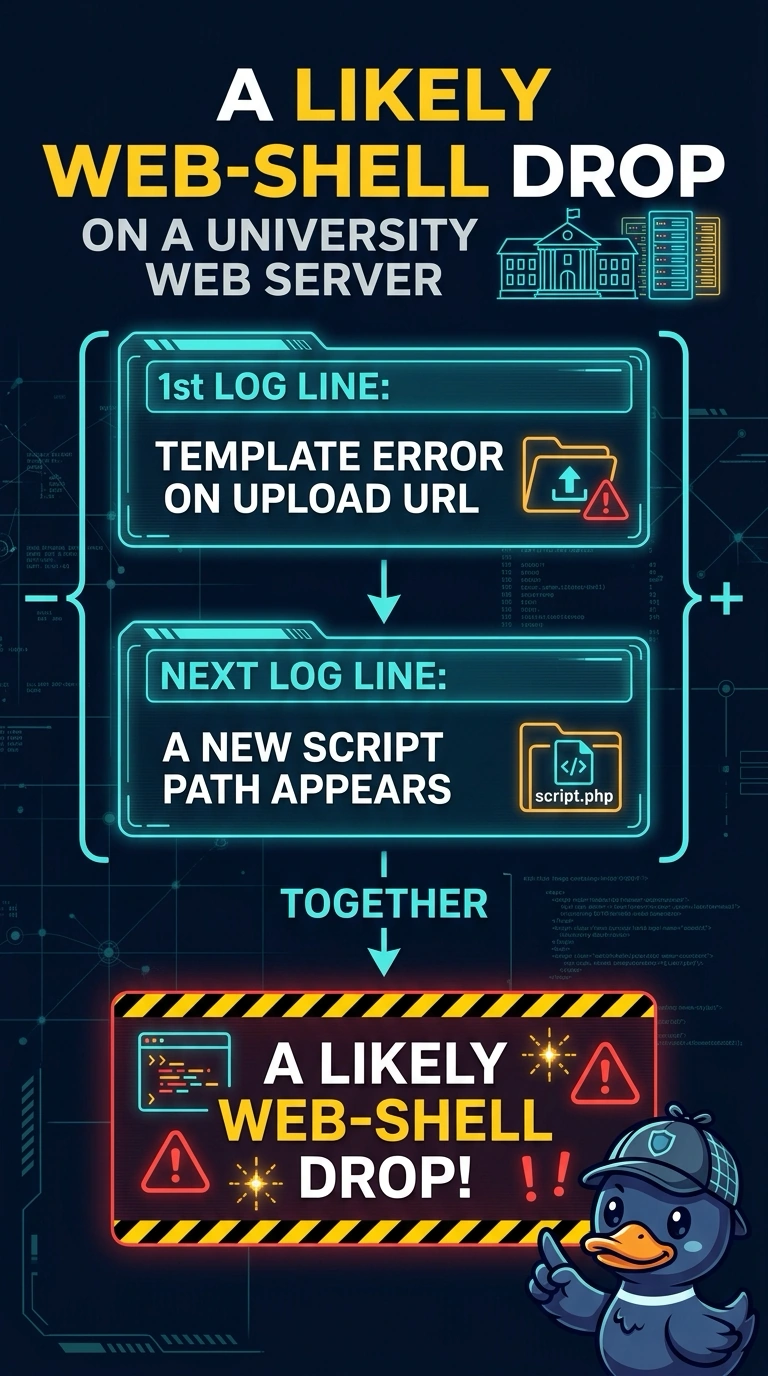
An application log on a university web server records a template error on the upload URL and, on the next line, a new script path that was not there before. How do those two lines form an indicator?
Select an answer to reveal the explanation.
Short Explanation
Read the two lines as one footprint: a stumble on the upload page, then a new script standing where it was not a moment ago. Together you have a likely web-shell indicator. The error alone does not prove the payload ran, and the path alone could be an ordinary publish.
Full Explanation
The indicator is the sequence, not either line in isolation. A template error on the upload URL immediately followed by a new script path ties a suspicious upload to a file that then appeared. The upload error and the new script path together mark a likely web-shell drop on that server. The template error by itself does not prove the uploaded payload already executed inside the server process; an application log of a request and an error status is not proof the payload ran. The new script path is not only routine template compilation and should not be ignored as a benign publish when it appears immediately after the upload error. The two lines do not cancel each other, so neither the template error nor the new path should be discarded; the adjacency is the indicator. Exam caveat: keep the pair as a candidate indicator and still confirm the file on disk, because a log line is not a substitute for the file hash. Operational check: export both lines with timestamps, note the new script path, and hash that file if it is still present without treating the error status as proof of execution.