
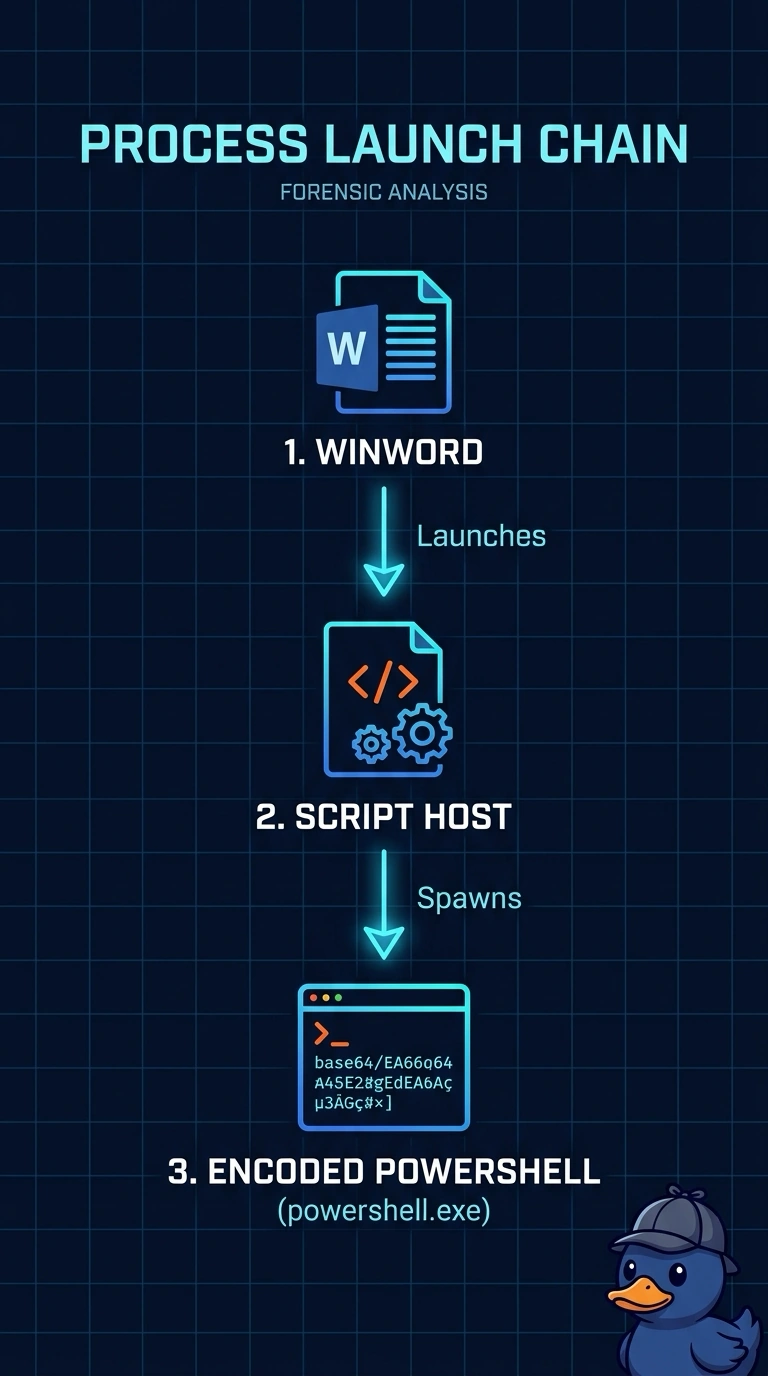
On a software-company workstation, the process tree shows WINWORD starting powershell.exe, which then starts a second encoded PowerShell. What does that parent-child chain imply?
Select an answer to reveal the explanation.
Short Explanation
Think of a memo that hires an assistant who then hires a coded second assistant. You are seeing WINWORD launch PowerShell and that host spawn an encoded follow-on, which is a suspicious document-to-script chain. Reading the tree backwards, calling it a restart, or blaming an embedded chart misses what the parents show.
Full Explanation
The parent-child chain runs from the document process downward: WINWORD launched a script host, and that PowerShell spawned an encoded second PowerShell process. That pattern means a document application started script execution and then a further encoded stage, which is not how a normal document open behaves. The timeline the tree supports is document, script host, then encoded script, and that order is the finding to write down. PowerShell is not the parent of WINWORD, so the chain does not make the document open an ordinary end-user action. A second PowerShell does not mean the first copy failed and the operating system restarted it; the tree shows a child of the first script host, not a service-recovery restart. An encoded PowerShell child is not expected when a document contains an embedded chart object, because charts do not launch encoded command hosts. Exam caveat: the chain shows who started whom, and it does not by itself name the macro, exploit, or template that caused Word to start the script. Operational check: record each process path, command line, and start time, and compare the encoded child with the parent PowerShell that Word created.