
A school browser running as a standard user spawned a child process that is running at high integrity. Why is that jump worth escalating in the review?
Select an answer to reveal the explanation.
Short Explanation
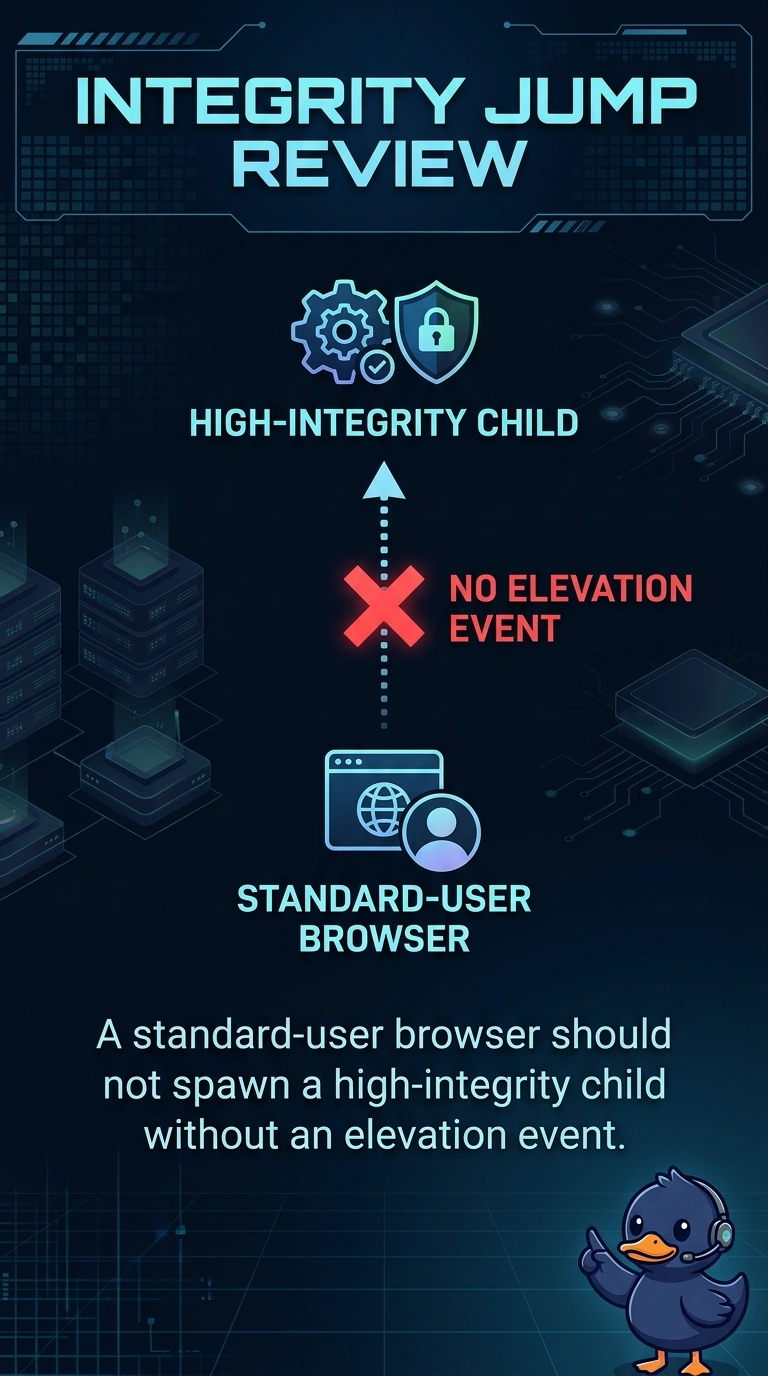
A student badge should not open the principal office. You have a standard-user browser spawning a high-integrity child, and that privilege jump is worth escalating in the review. High integrity is not the usual level for such a child, the clue is not limited to a misplaced service host, and integrity levels are not disk encryption.
Full Explanation
A process running as a standard user holds a medium integrity token, and its children normally stay at that level or drop lower inside a browser sandbox. A standard-user browser should not spawn a high-integrity child without an elevation event, so the jump suggests privilege escalation and belongs high in the review. High integrity is not the usual level for browser child processes, and the spawn does need extra review. The integrity jump does not matter only when the child is svchost running from a user profile path; the integrity change is the signal, whatever the child is named. Integrity levels do not describe disk encryption state, so the parent browser should not be quarantined for that reason; disk encryption is a volume control, while integrity is a process token attribute. Exam caveat: if the parent browser were already an elevated admin session, a high-integrity child would be less surprising, and this parent is a standard user. Operational check: record the parent integrity, the child integrity, and any elevation or consent event at that timestamp before you rank the alert.