
An investigator must determine whether a sensitive file was created on an NTFS volume and later deleted. Which filesystem metadata structure answers that?
Select an answer to reveal the explanation.
Short Explanation
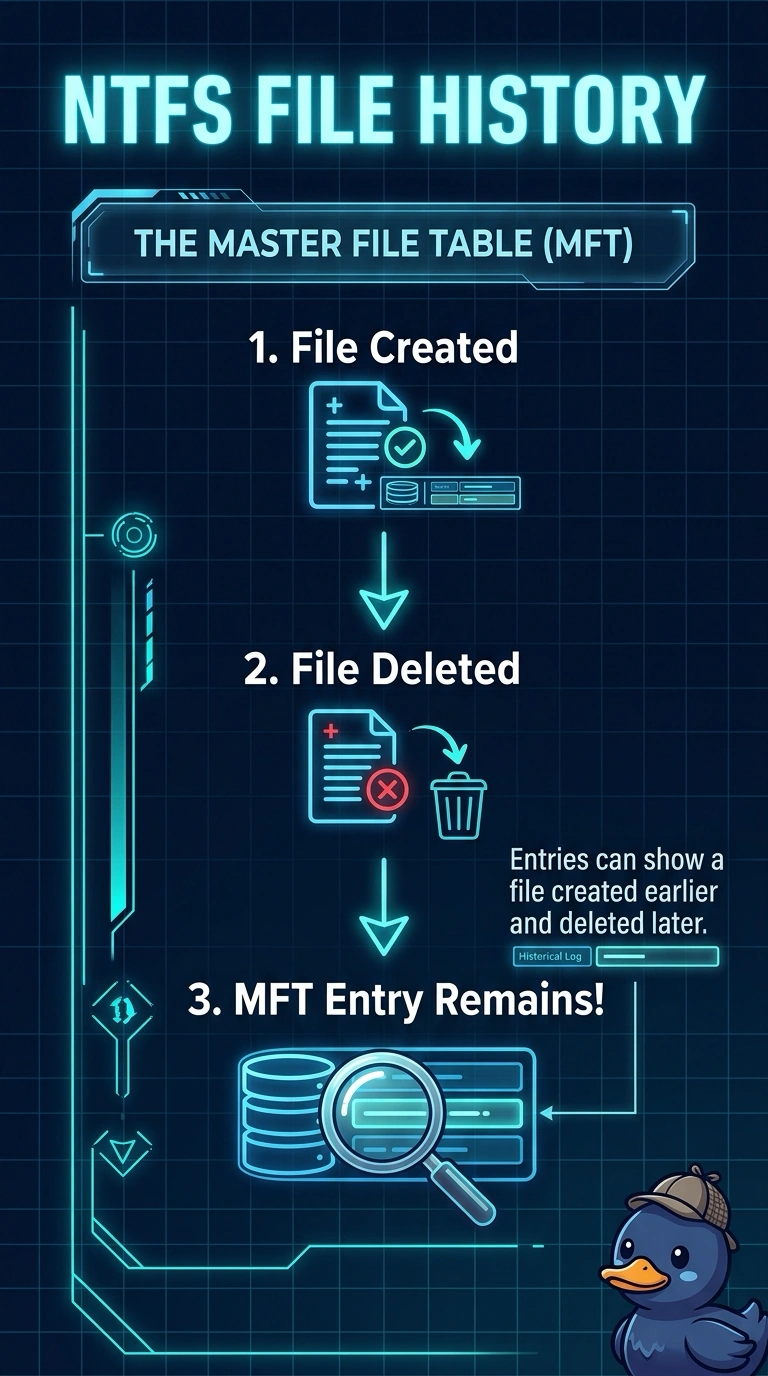
The library card can remain in the drawer after the book is gone. You read the Master File Table for entries that still show a file created earlier and deleted later. Prefetch, bash history, and a web error log are the wrong cabinets for NTFS create and delete.
Full Explanation
On NTFS, the Master File Table holds a record for each file, and a deleted file can leave an entry that still shows it was created earlier and deleted later, until that record is reused. That is the metadata structure that answers whether the file existed and was removed. The Prefetch directory records program execution on Windows, and treating it as the archive holding full contents of every deleted file mixes execution with file contents. The bash history file is a Linux shell artifact, and treating it as the NTFS record of file creation and deletion events puts a shell notebook in place of filesystem metadata. The web error log records server problems, and treating it as the metadata journal for NTFS create and delete actions confuses an application log with the filesystem. Correlate the deleted entry with retained journal or independent event evidence; MFT timestamps alone do not date deletion. Exam caveat: if the table entry was reused, absence of the name does not prove the file never existed. Operational check: parse the Master File Table for a deleted entry matching that filename and inspect its creation metadata and allocation status, then correlate a retained USN_REASON_FILE_DELETE journal event and timestamp to establish deletion timing.