
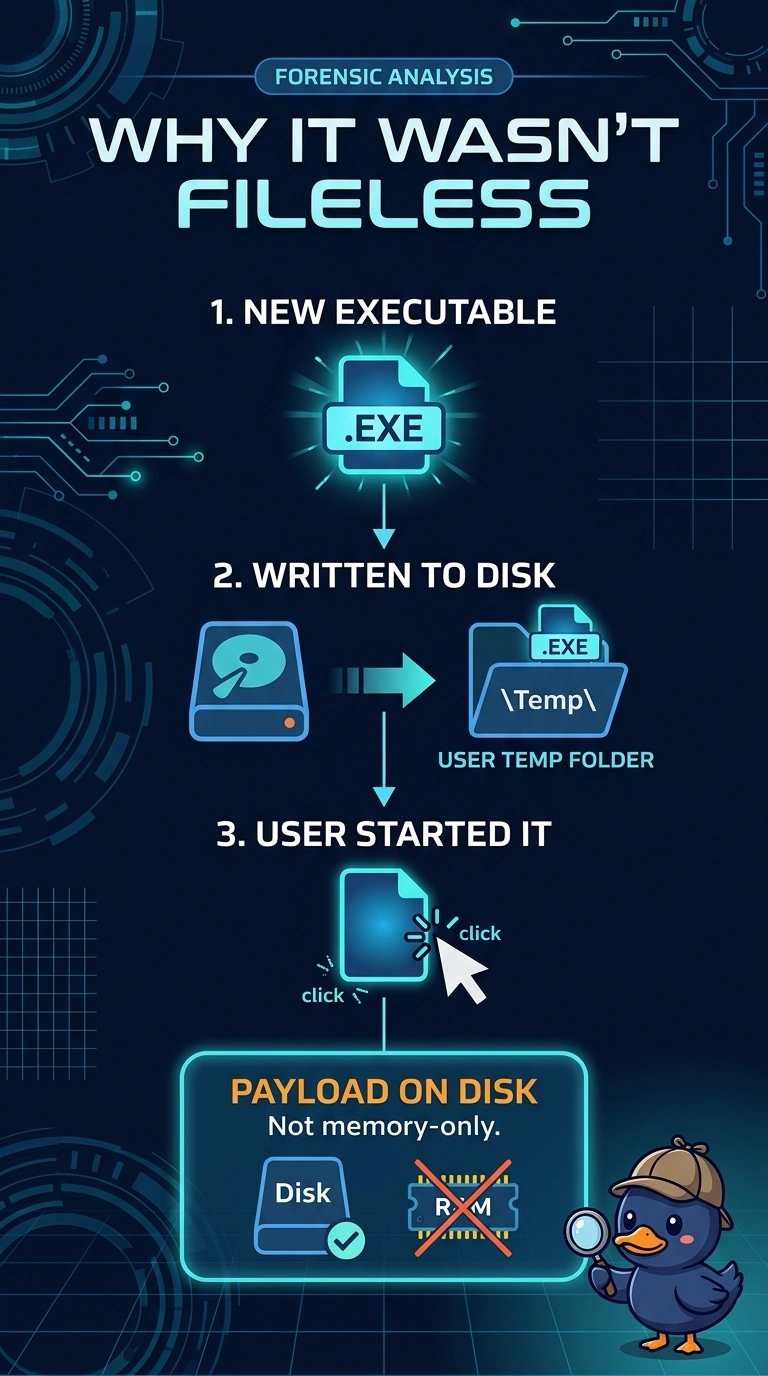
An executable appeared in a user Temp folder and was started with a double-click. Why does this case fall outside the fileless pattern?
Select an answer to reveal the explanation.
Short Explanation
A package on the desk that someone opened is not a ghost in the air. You are looking at a new executable written to disk and started by a double-click, which is ordinary file execution. An unsigned file in Temp is still a file, so this opening act is not the fileless pattern.
Full Explanation
The fileless pattern is execution without the attacker's own executable written to disk, often inside a trusted process or in memory. A new executable was written to disk and started by the user, so the payload was not memory-only; a double-click of a Temp binary is ordinary user execution of a file. A double-click launch from a Temp folder is not fileless whenever the binary is unsigned and the parent is the shell; missing a signature and a shell parent describe a suspicious file, not a memory-only payload. Any program that starts from a Temp path is not fileless by the nature of that directory; the folder name does not erase the file. Fileless does not mean the user clicked a prompt, whether or not a new file was created on disk; a click is an action, and the defining point is whether a payload file was written and run. Exam caveat: this executable could still be a dropper that later injects code, but the double-click itself is not the fileless pattern. Operational check: hash the file on disk, record the parent process that launched it, and keep the binary with the case.