
A reflective loader on a developer workstation mapped a library into a running process, and that module has no file at the listed path. Which artifact still holds the code?
Select an answer to reveal the explanation.
Short Explanation
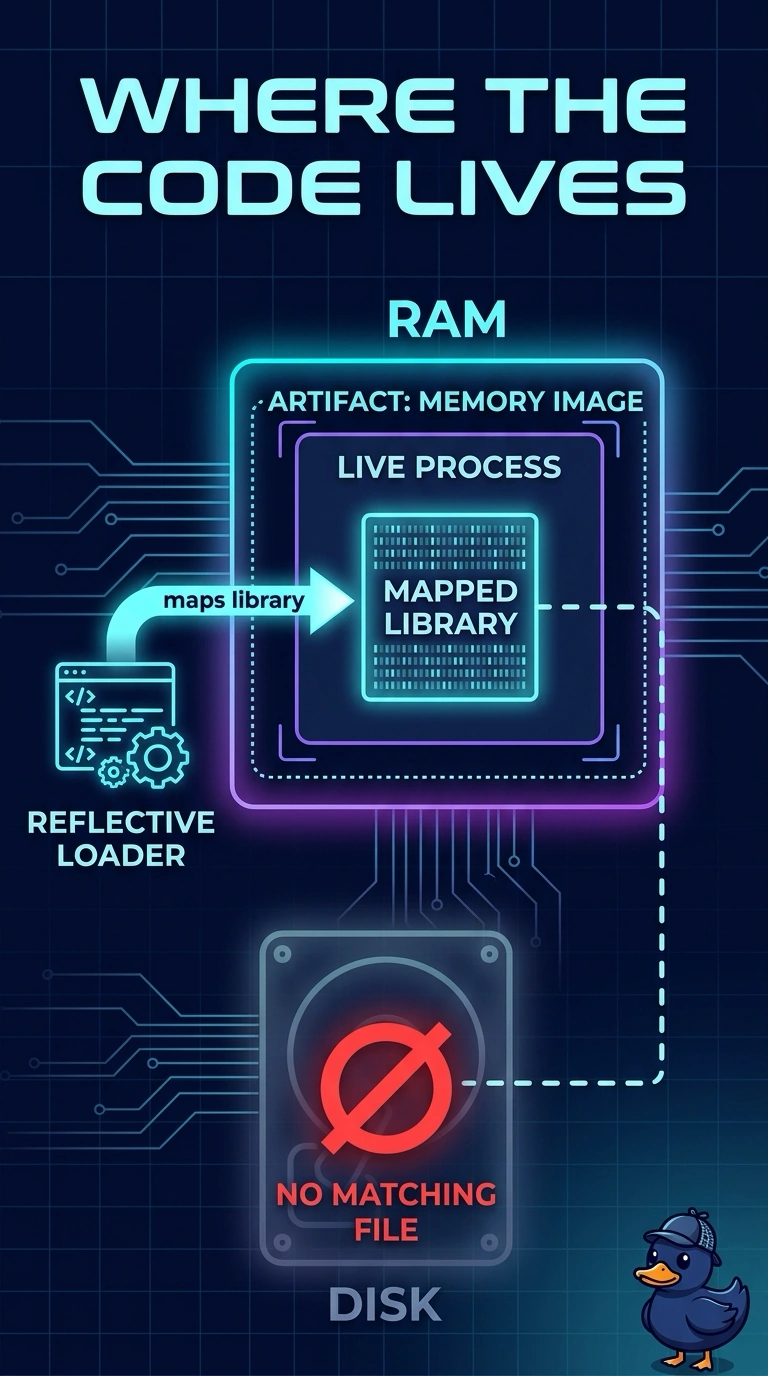
The note is on the whiteboard in front of you, not in the filing cabinet. The mapped library lives in process memory and has no file at the path listed, so a memory image is what still holds the code. Prefetch and an old profile copy are pictures of disk, and this code did not land there.
Full Explanation
Reflective loading places executable bytes in a process address space without a corresponding file on disk. A memory image of the live process, where the mapped library resides in RAM and has no matching file on disk, is the artifact class that still holds the code. The prefetch folder, a record of programs that were launched from a path on disk, does not store a module that never had a file to launch. An older offline copy of the user profile, taken before the loader mapped anything, predates the injection and cannot contain those bytes. A reputation score for the process name, with no memory capture and no file required, judges a name that may belong to a legitimate host process and does not recover the mapped code. Exam caveat: if the process has already exited and no memory image was taken, the bytes may be gone, which is why memory is collected while the host is still running. Operational check: in the memory image, locate a mapped executable region that has no backing file path and compare it with the process that was running at collection time.