
Two samples may carry the same mutex name, and the analyst will not open either file in a debugger. How can strings output on both files answer that?
Select an answer to reveal the explanation.
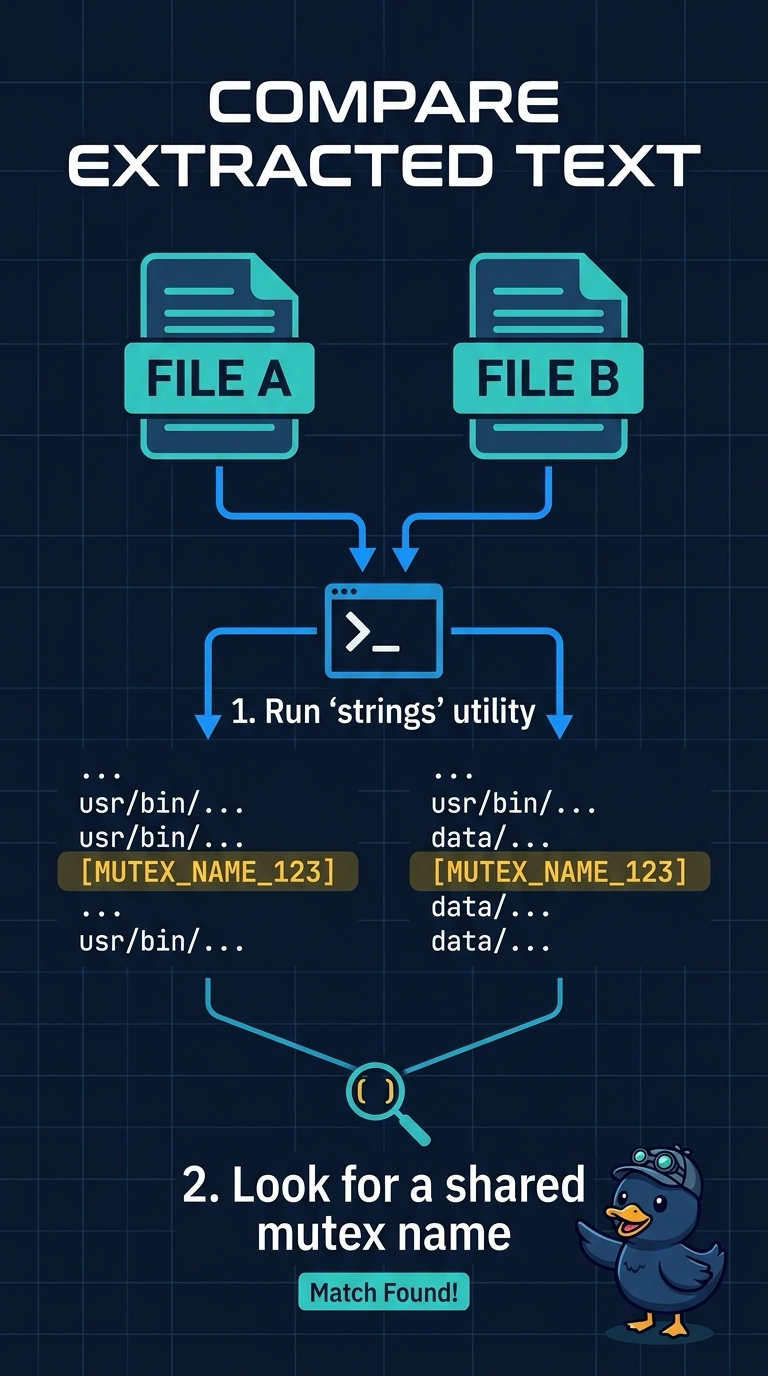
Short Explanation
Two locked boxes can share a word printed on the outside, and you compare the words without prying the lids off. Running strings on both files shows the extracted text, including a mutex name stored in the clear, without a debugger. Stepping the samples, detonating them, or comparing only hashes does not answer the question the same way.
Full Explanation
You run strings on both files and compare the extracted text for a shared mutex name, which answers the question from bytes on disk. If the mutex is stored as readable text, it shows up in that output, and you do not have to execute either sample to see it. If you step both samples in a debugger and pause when each one creates a mutex, you run the code and watch a live call, which was refused. If you detonate both samples in a sandbox and read the mutex name from the report, you also execute them and depend on the sandbox reaching that behavior. If you hash both files and treat equal digests as proof they embed the same mutex, you only learn whether the files are byte-identical, not whether a shared string exists in two different files. Cleartext in the file is the condition that makes the mutex visible to strings. Exam caveat: strings misses a mutex that is encoded or built only at runtime, so a miss is not proof the samples are unrelated. Operational check: run strings on each file, search the extracted text for the mutex, and confirm no debugger or sandbox process was started to produce that result.