
On a Linux analysis workstation, objdump is pointed at a malware ELF that has not been launched. What safety property does that choice rely on?
Select an answer to reveal the explanation.
Short Explanation
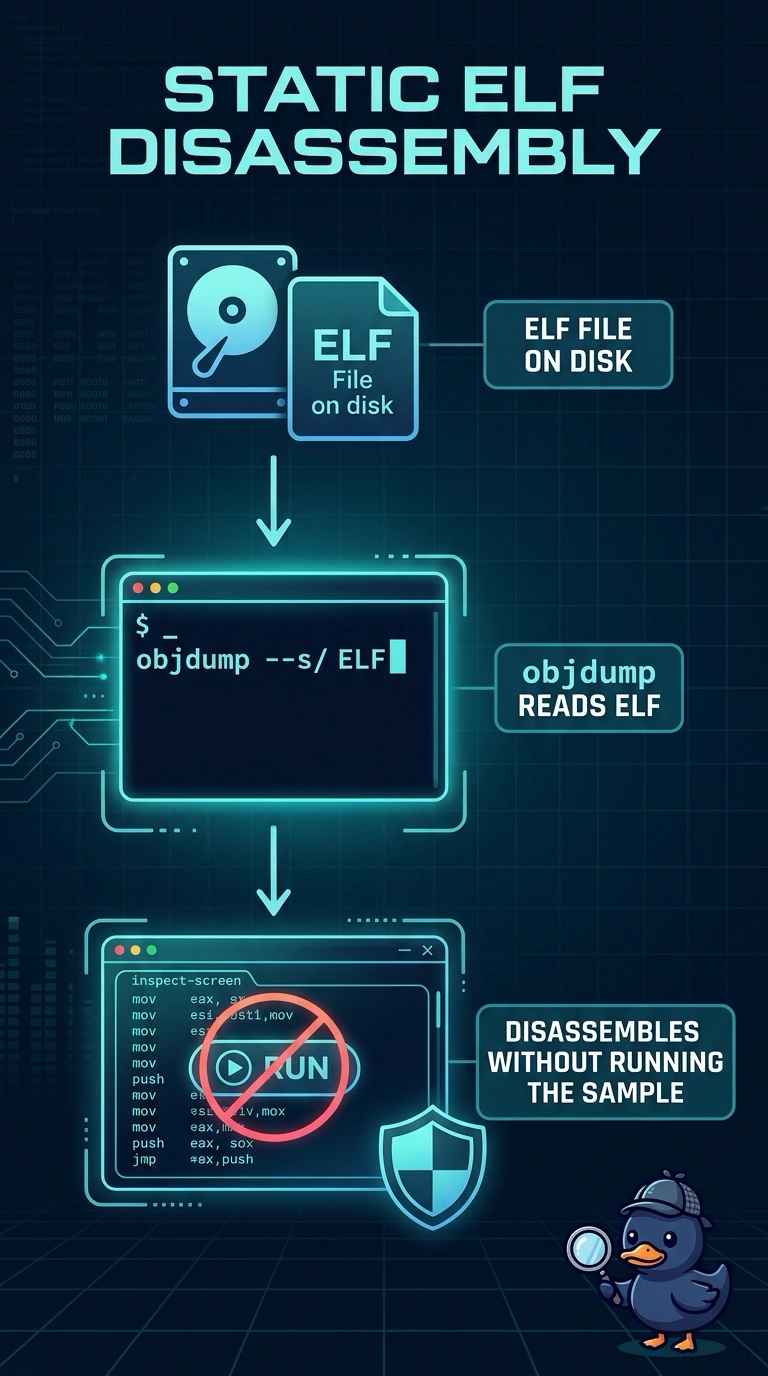
Reading a recipe aloud is not the same as cooking the dish, and you can study this ELF the same way. objdump reads the file from disk and can disassemble it without executing the sample. Requiring a launch, a sandbox detonation, or an entry-point run mistakes a static dump for a live execution.
Full Explanation
objdump reads the ELF from disk and can disassemble it without running the sample, which is why pointing it at an unlaunched file is a static step. It parses headers and instructions from the bytes on disk; the sample does not become a running process. It is false that objdump must execute the ELF entry point on the host before it prints a disassembly. It is false that objdump reads the bytes only after the sample has been launched on Linux; permission to read the file is enough. It is false that objdump detonates the ELF in a sandbox and then prints the guest output; there is no guest run in this step. Disassembly is a reading of the encoded instructions in the file, and the processor does not fetch those bytes as a running program while objdump works. Exam caveat: a crafted file could target a parser bug, so keep the analysis host isolated, but the design of the tool is still to read and disassemble rather than execute. Operational check: run objdump against the ELF and confirm the process list shows objdump and does not show the sample name as a program that executed.