
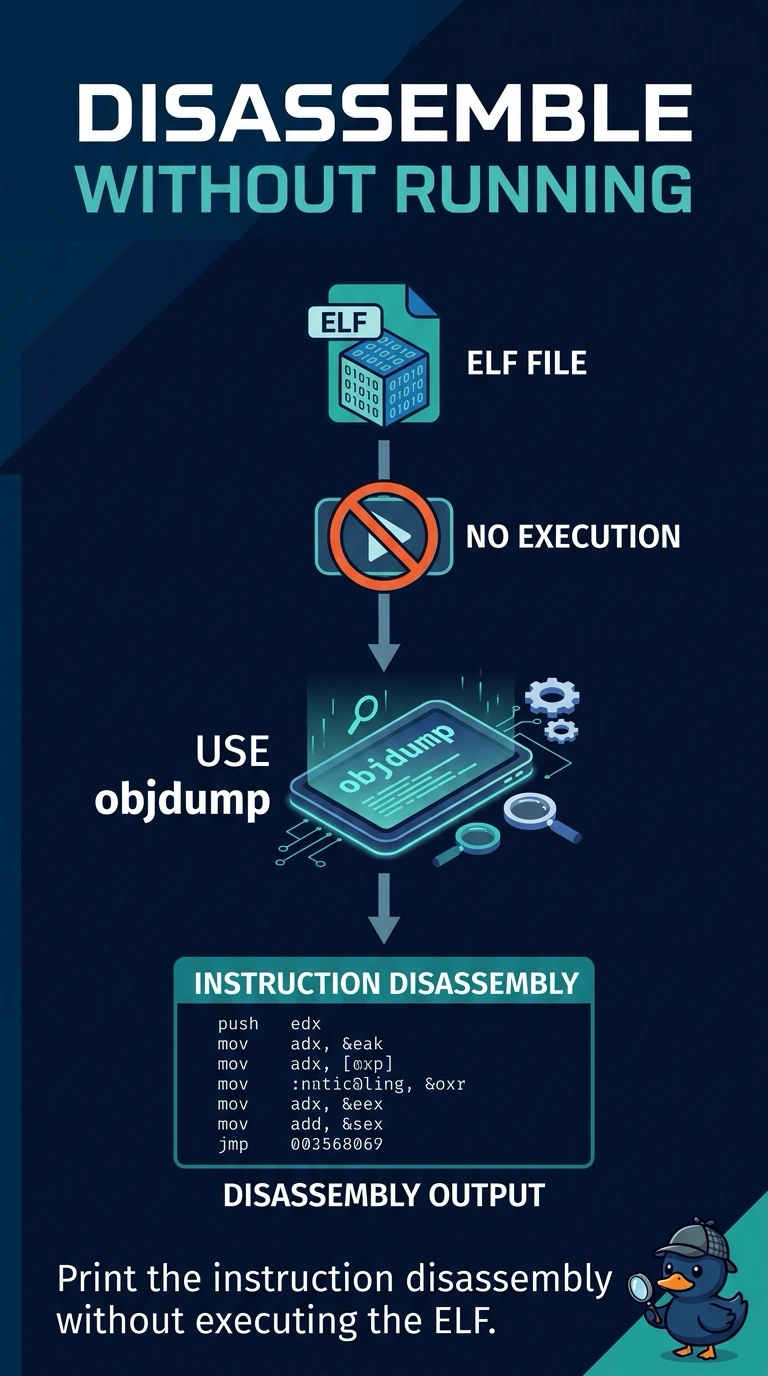
A lab copy of a suspicious ELF must be disassembled, and the file must not be executed. Which tool role matches that need?
Select an answer to reveal the explanation.
Short Explanation
Disassembly is a blueprint reading, and you do not have to start the machine to read it. You use objdump to print the instruction listing without executing the ELF. strings, the file summary, and a live tracer are not that blueprint.
Full Explanation
objdump reads the ELF bytes and prints the instruction disassembly without executing the ELF, which is the static role this lab copy needs. The machine code becomes visible as instructions while the file never runs, so a hostile constructor or entry point stays dormant. Execute the ELF under a system-call tracer on the lab server and read that trace and you have left static analysis; the tracer requires the program to run. Run strings and treat the printable fragments as if they were disassembly and you only collect readable byte runs, not opcodes. Use file and treat the format summary as a full instruction listing and you stop at a one-line identification of ELF class and machine, which is not a disassembly. Exam caveat: objdump shows the bytes it can decode at rest, and packed or encoded bodies may still need a later unpack before the interesting instructions appear. Operational check: run objdump disassembly against the lab copy, confirm instructions are printed, and confirm the process list never shows that ELF executing. Save the disassembly beside the file hash in the case notes.