
A branch-office application writes events that each wrap across multiple log lines, and the team needs those fields pulled out and counted. When does a short Python parser beat a single-line Bash cut?
Select an answer to reveal the explanation.
Short Explanation
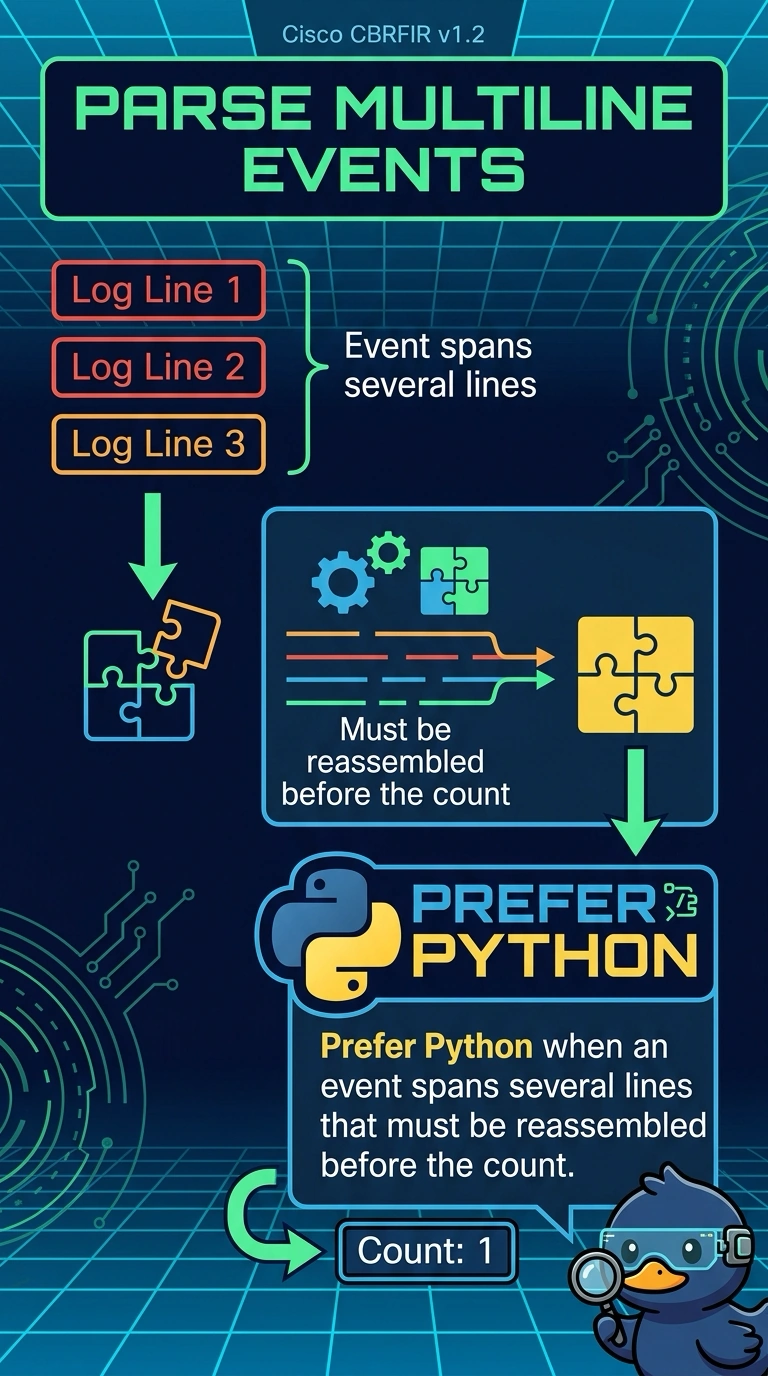
When your events wrap across multiple lines, you need a parser that can bring each event back together before counting its fields. You reach for Python to reassemble the lines and tally the records. cut can split a single delimited line, but it cannot reassemble a wrapped event.
Full Explanation
cut splits a line on a delimiter and prints selected fields; it does not know that several physical lines belong to one event. Prefer Python when an event spans several lines that must be reassembled before the count: a short parser can buffer lines until the record ends, extract the needed fields, and increment the tally. cut can select fields in that simpler case; a separate counting step is still needed for totals, and it does not reassemble these wrapped events. Prefer grep when a case-insensitive search is enough and matching lines are the whole result addresses a search, not extraction and counting of fields across reassembled records. Prefer cut when the file is a packet capture and the task is to decode payloads into URL text gives cut a decoding task it does not perform; the input here is an application log, not a packet capture. Exam caveat: cut is appropriate for already-delimited single-line records, but not for joining lines into events. Practical check: print one raw event to confirm it spans multiple lines, then verify that the parser emits and counts it as one record.