
On a factory floor, an analyst finds a PE with almost no imports and a section marked both writable and executable. Where should the first review of that file take place?
Select an answer to reveal the explanation.
Short Explanation
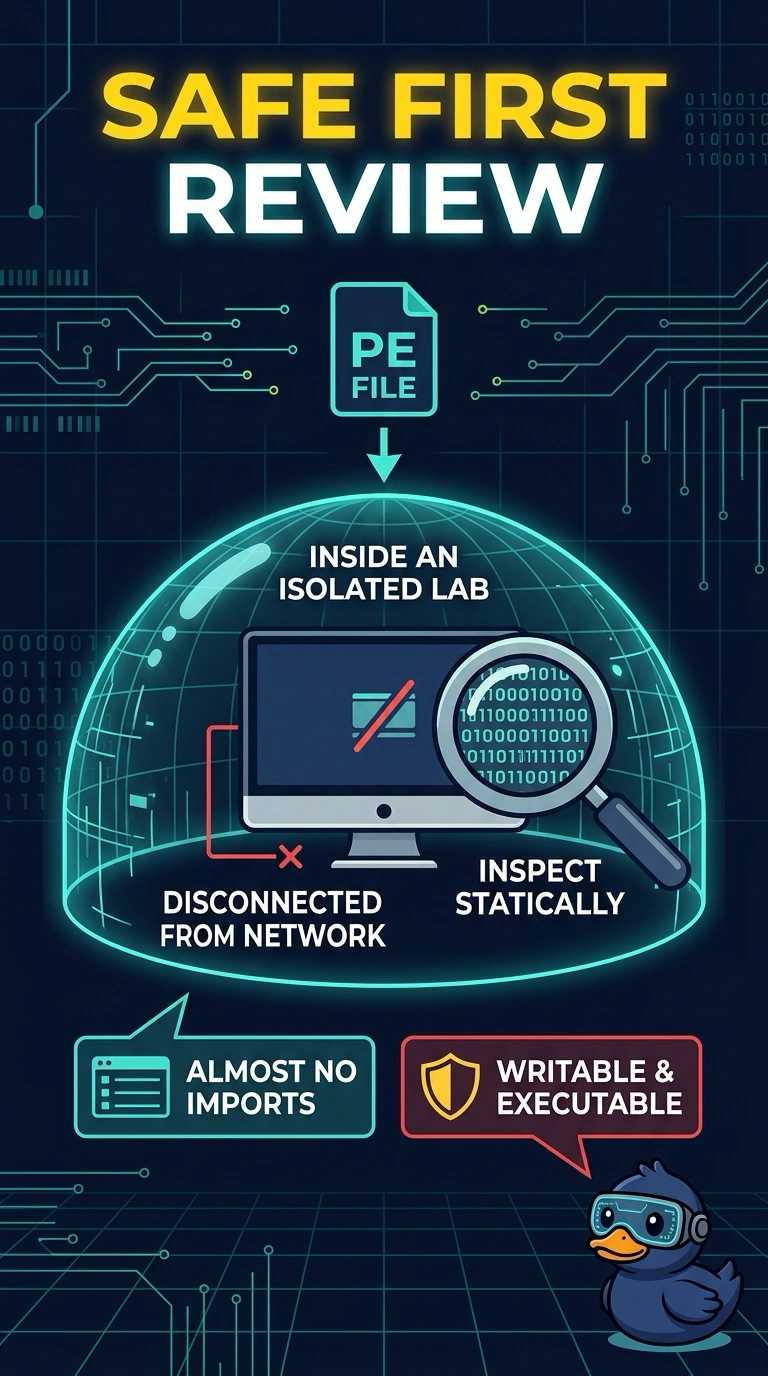
You wouldn’t test a suspicious engine on the company truck. The PE’s flags are visible in a static review inside an isolated lab, so you don’t launch it on a domain computer. A filename lookup or a double-click on a shared jump host skips that safe first look.
Full Explanation
Almost no imports and a section marked both writable and executable are structural warnings you can read from the PE itself. The right first review is to inspect the PE statically inside an isolated lab instead of launching it on a domain computer, where a packed stub could run with domain credentials. Launching the PE on the domain-joined analyst computer to see live behavior puts that stub on a production identity, the opposite of a contained review. Submitting only the filename to a reputation lookup and skipping byte-level review ignores the import table and section flags—the actual clues—and a filename is not the file hash. Copying the PE onto a shared jump host and double-clicking it under the analyst domain account is still execution on a domain system, only on a different host. Exam caveat: later detonation in a sandbox can be useful after the static pass, but it still does not belong on the analyst computer. Practical check: in the lab, review the import table and section characteristics before any execution, and confirm the factory workstation has no copy of the sample.