
A retail file server has held a long-lived session to a rarely seen external host, moving many bytes in relatively few packets. Why is corroborating content and authorization evidence needed before that session is called data theft?
Select an answer to reveal the explanation.
Short Explanation
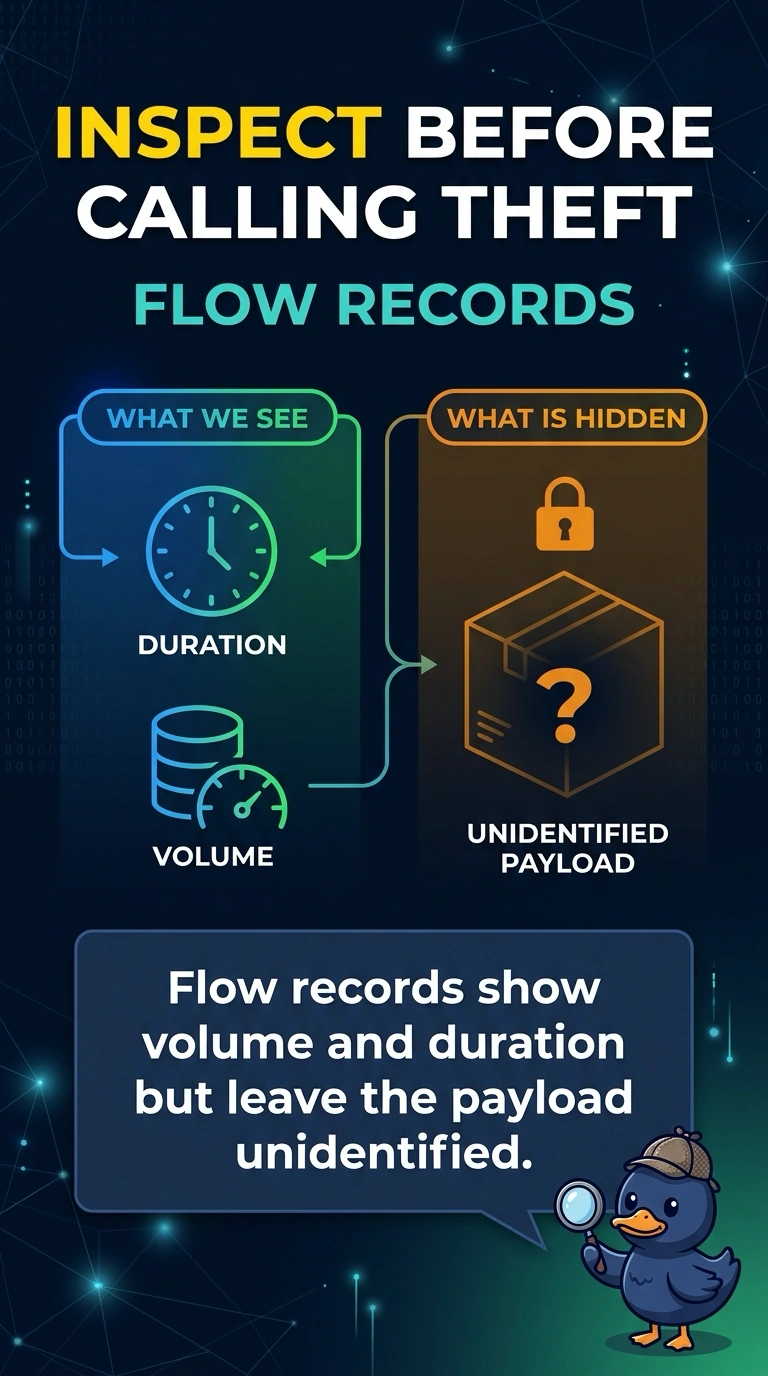
You have a useful clue: the session moved many bytes over a long time, but the flow records do not tell you what was inside. Corroborate the content and authorization before calling it theft; volume and duration alone are not proof.
Full Explanation
Flow records summarize who communicated, along with volume and duration, but leave the payload unidentified. A long-lived session that moves many bytes in relatively few packets to a rare external host is a meaningful lead, not proof of theft: the same pattern can reflect authorized activity. A rare external peer plus a long session is not enough to prove file theft, because those characteristics do not establish what moved or whether the transfer was unauthorized. Increasing the sampling rate may affect how many conversations are recorded, but it does not put file contents into later flow records. Flushing the collector cache removes the session summary; deleting that record cannot confirm what was transferred or prove theft. Exam caveat: volume and duration justify further investigation, not a finished finding of data theft. Practical check: corroborate what the conversation carried and whether the transfer was authorized before escalating it as theft.