
An Apache access log at a city library proves a suspicious request arrived and records the status that was returned. Why is that log not yet proof the exploit payload executed?
Select an answer to reveal the explanation.
Short Explanation
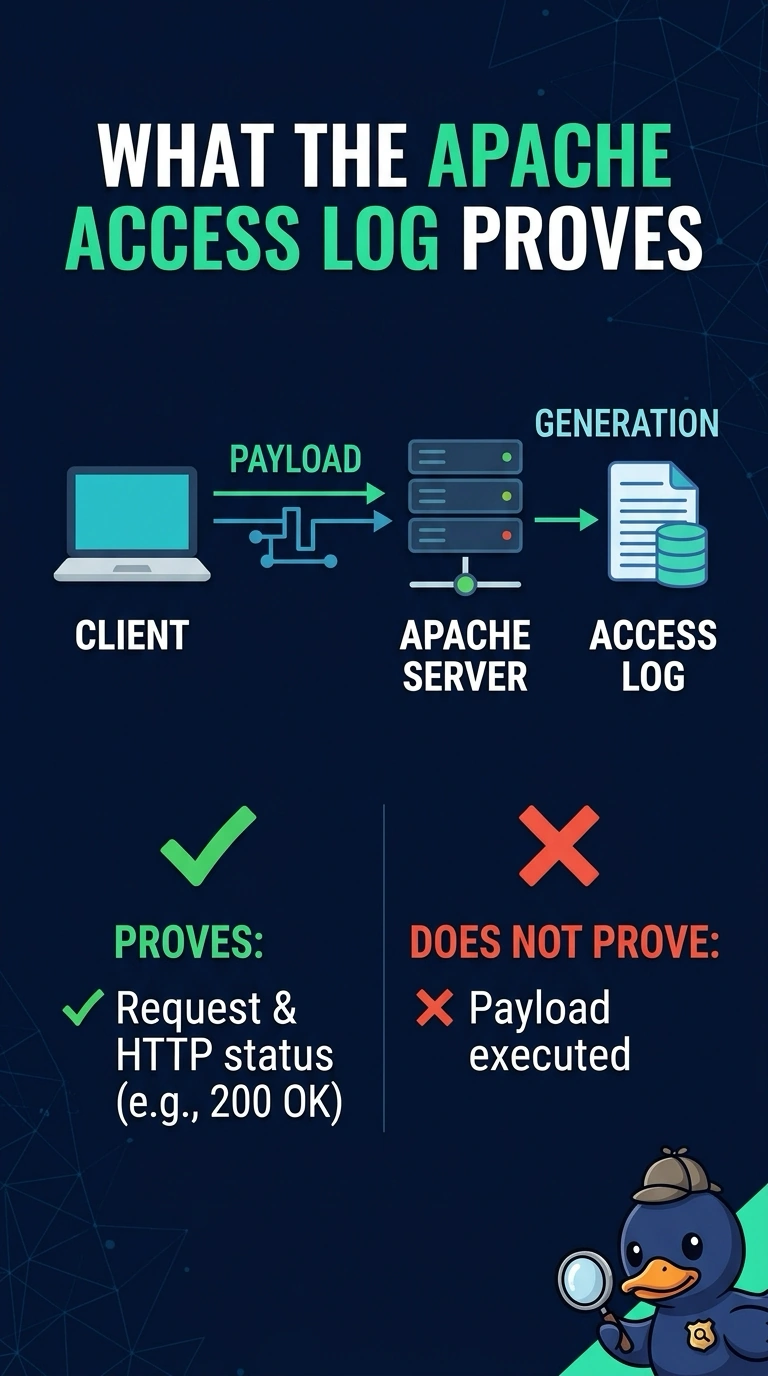
An access log is a guestbook, not a witness to what happened in the back room. You know the request arrived and which status was returned, and that record still does not prove the payload executed. A status code, a supposed memory copy, or a script name on the line is not that proof.
Full Explanation
An Apache access log records the request and the status returned to the client. That is evidence the request was received and how the server classified the response, and it does not prove the payload executed. Treat the access line as the starting coordinate for the request, then look elsewhere before you upgrade a logged request into proof of compromise. Any recorded status code, including success or an error, does not mean the payload already ran inside the web server process; the code is an outcome label, not a process trace. The access log does not store a copy of worker memory, so execution is not already captured in that file. A script name on the request line shows what was requested, and it is not enough to conclude the payload executed on the server; the application may have rejected the body, failed before the payload, or logged a request that never reached the interpreter. Exam caveat: pair the access line with error-log entries, a new file on disk, or a process record before you claim the exploit ran. Operational check: take the timestamp and request from the access log and look for a matching worker process, a dropped file, or an error-log line at that same moment.