
An Apache request line on a university portal contains the sequence %2e%2e%2f inside the URL path. What is that encoding hiding?
Select an answer to reveal the explanation.
Short Explanation
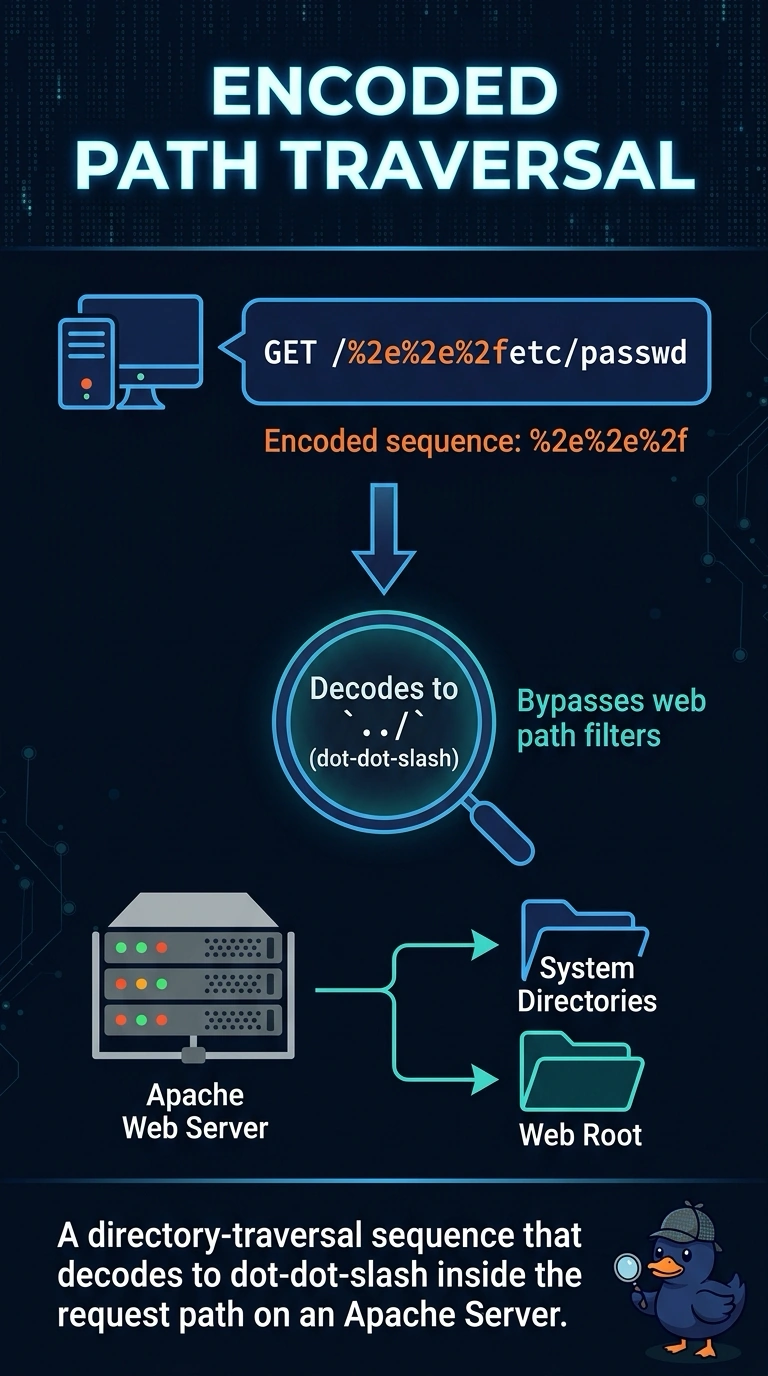
Percent-encoding is a costume, not a lock. The sequence %2e%2e%2f is dot-dot-slash, a directory traversal hiding in the request path. You should not read that costume as encryption, a cipher choice, or a session cookie.
Full Explanation
Percent-encoding writes a byte as a percent sign and two hex digits. In this path, %2e is a dot and %2f is a slash, so %2e%2e%2f decodes to dot-dot-slash, a directory-traversal sequence inside the request path. The encoding hides the traversal from a filter that only looks for the raw characters. It is not a base64 value that encrypts an administrator password; base64 is an encoding, this string is percent-encoding, and neither one is encryption. It is not a TLS marker that selects the cipher suite for the following portal request; cipher choice is negotiated in the handshake, not stored as %2e%2e%2f in the URL path. It is not a session cookie that stores the login state after an ordinary campus visit; a cookie is a separate header, not this path sequence. Exam caveat: seeing the encoded traversal in the access log shows the request was sent, not that the server decoded it and returned a file outside the site root. Operational check: decode the path bytes, confirm they become dot-dot-slash, and compare the response status and size with a normal page before you treat the traversal as successful.