
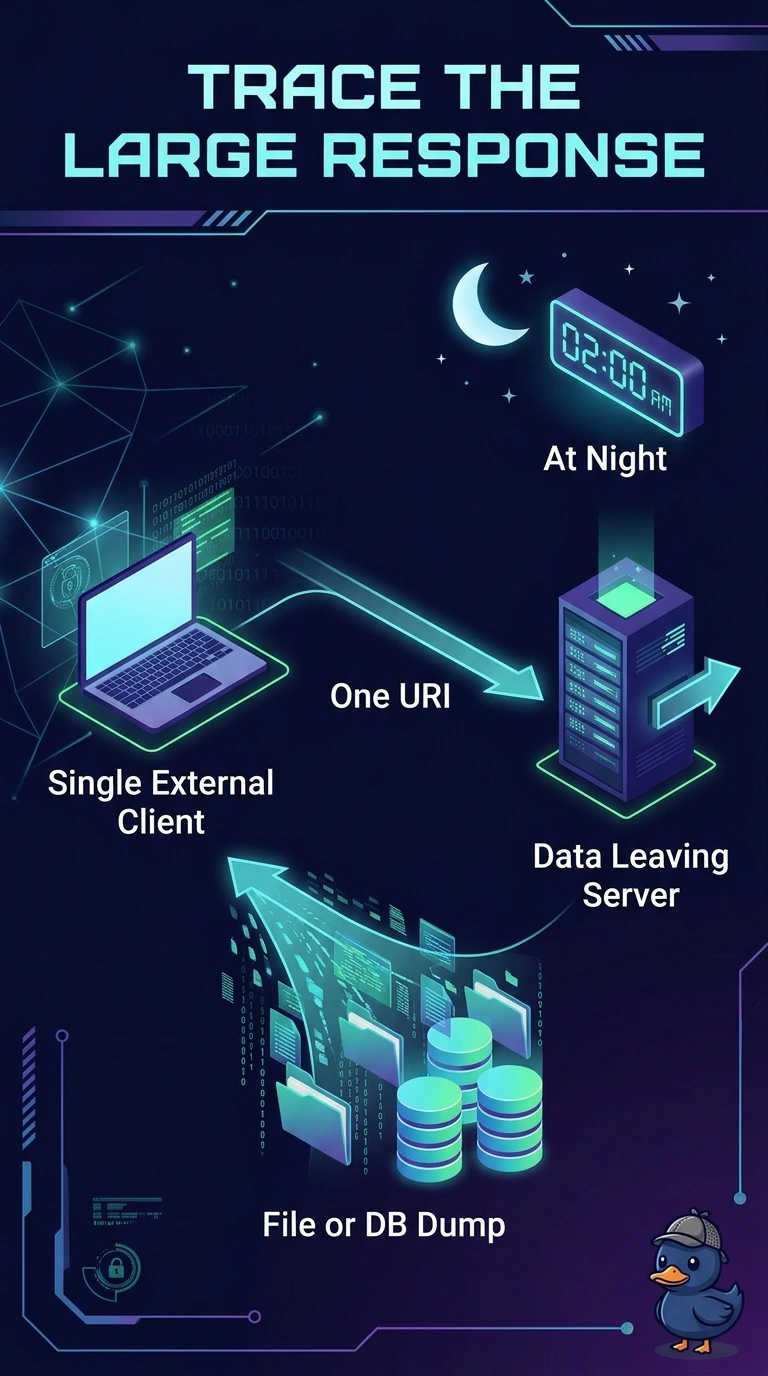
At night, one URI on a bookstore web server returns an unusually large response body to a single external client. What should the analyst investigate on that path?
Select an answer to reveal the explanation.
Short Explanation
You have a useful lead when one URI sends an unusually large response to one external client overnight. Investigate data leaving the server, such as a file or database dump, before treating the response as a scheduled backup or certificate renewal.
Full Explanation
The access-log byte count shows how much left the server on that URI, not what the bytes contained. An unusually large response body sent to one external client at night is a lead for data leaving the server, so investigate whether that path returned a file or database dump to the client. A password-spray page is a poor fit: a spray involves many authentication attempts, not one unusually large response, so treating the body as a pile of failed logins does not match the log pattern. A healthy nightly backup can move substantial data, but that does not establish that one external client retrieving one URI is an expected scheduled archive; verify the path before concluding that. Certificate renewal is a separate PKI workflow, which can use an HTTP-based protocol such as ACME; this application response alone establishes neither renewal nor theft. Exam caveat: response volume is a lead, not proof of theft; a legitimate download can also be large, so identify the content before classifying the event as an incident. Practical check: retrieve the access-log entry for the client, URI, time, and byte count, then inspect what the application returns for that path or what the server stored there.