
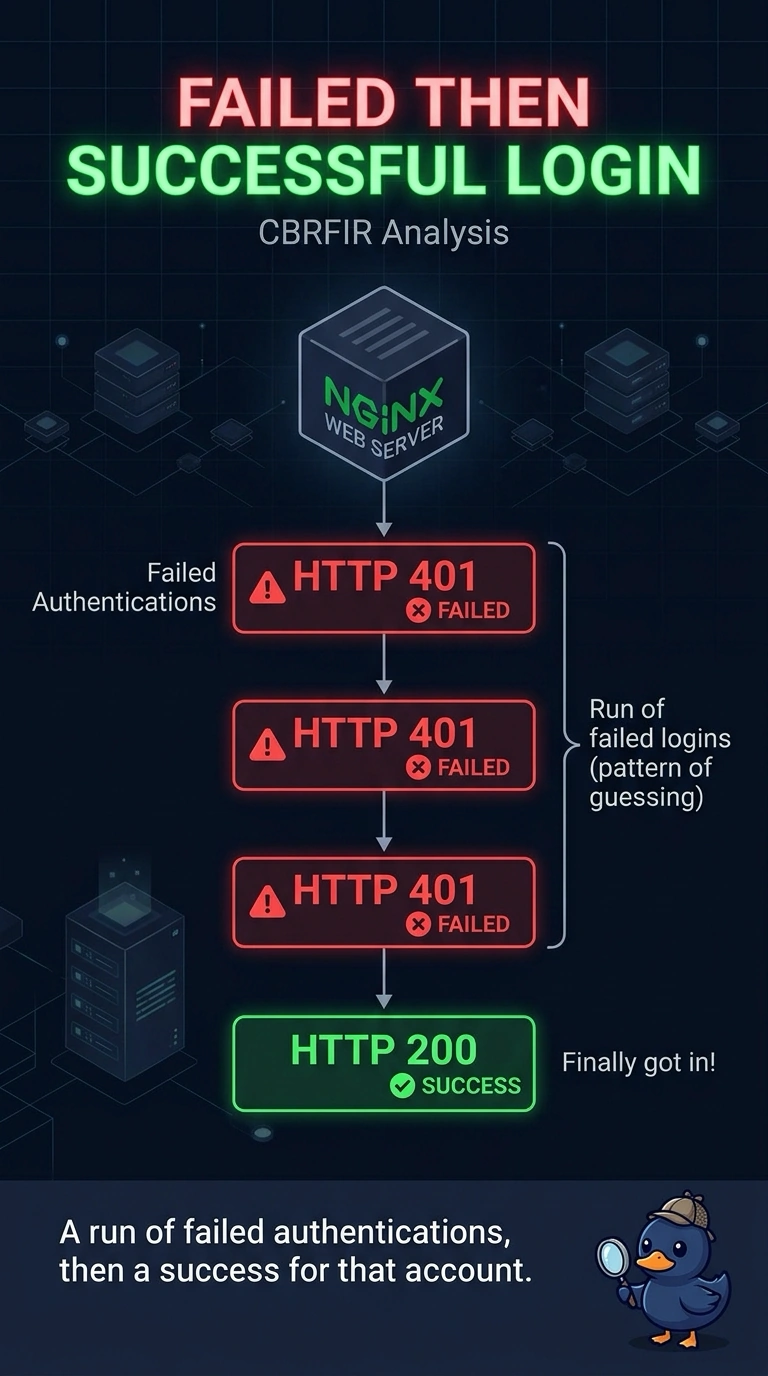
NGINX logs repeated requests to the same authentication-protected resource for one account: application authentication records confirm failed attempts corresponding to 401 responses, then a successful login corresponding to a 200. What does that sequence suggest?
Select an answer to reveal the explanation.
Short Explanation
Corroborated authentication failures followed by a successful login suggest password guessing, although legitimate mistakes remain possible. HTTP 200 alone proves request success, not successful authentication. You will do best when you do not let the success erase those earlier failures, take it as proof an administrator reset the password, or mistake it for a full disk.
Full Explanation
Corroborated authentication failures followed by a successful login suggest password guessing, although legitimate mistakes remain possible. HTTP 200 alone proves request success, not successful authentication. Calling this a harmless login because a success status wipes out earlier failures ignores the attempts that make the sequence meaningful. The sequence does not prove an administrator reset the account password during the burst: the log shows authentication results, not a password-change action. Nor do the 401 responses indicate a full disk; that interpretation mistakes an authentication status for a storage problem. Keep the client address alongside the account so a burst from a shared source stays visible, and do not stop your review at the single success line. Exam caveat: a legitimate user might mistype a password and then succeed, so confirm the client and timing before calling the activity a compromise. Practical check: group the lines by account and client, then see whether the 401 responses and the 200 share the same source.