
An attacker placed one file hash into a public folder that many systems can read. Why must that hash be corroborated before the company is scoped on it alone?
Select an answer to reveal the explanation.
Short Explanation
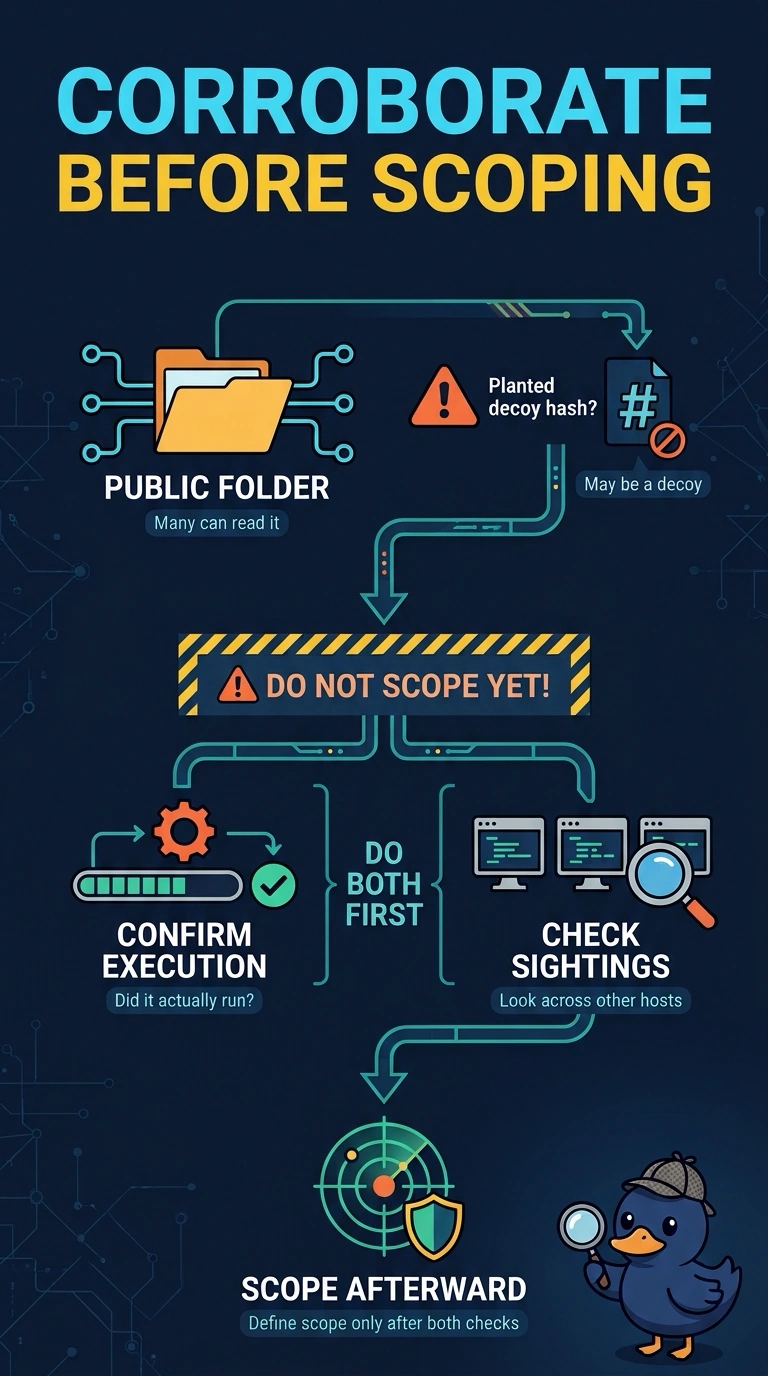
One ugly sticker dropped in the lobby is not proof every office ran a program. You confirm execution and real sightings before you scope the company, because a hash in a public folder can be a planted decoy. File presence on a share people can read is not the same as a process that started.
Full Explanation
A single indicator planted where many hosts can read it is a classic false artifact: it creates noise and invites an oversized scope. Confirm execution and other host sightings before company scope, as one hash written into a public folder can be a planted decoy; presence on a share is not execution. Treat that public-folder hash as proof every system able to read the folder executed the file and you equate read permission with a process start. Ignore the hash on the view that attackers are unable to write files into a folder marked public and you assume a writable share is immutable; if the attacker could write the decoy, the write itself is a lead, but it is not enterprise-wide execution. Finish company scope as soon as one hash is known, without checking whether any host actually ran it, and the decoy becomes the scope decision. Exam caveat: a weak or planted indicator is hunted and corroborated, not used as a company-wide declaration of compromise. Operational check: search for a process start or other execution artifact for that hash, and keep a readable copy in the public folder in a separate column from hosts that actually ran it.