
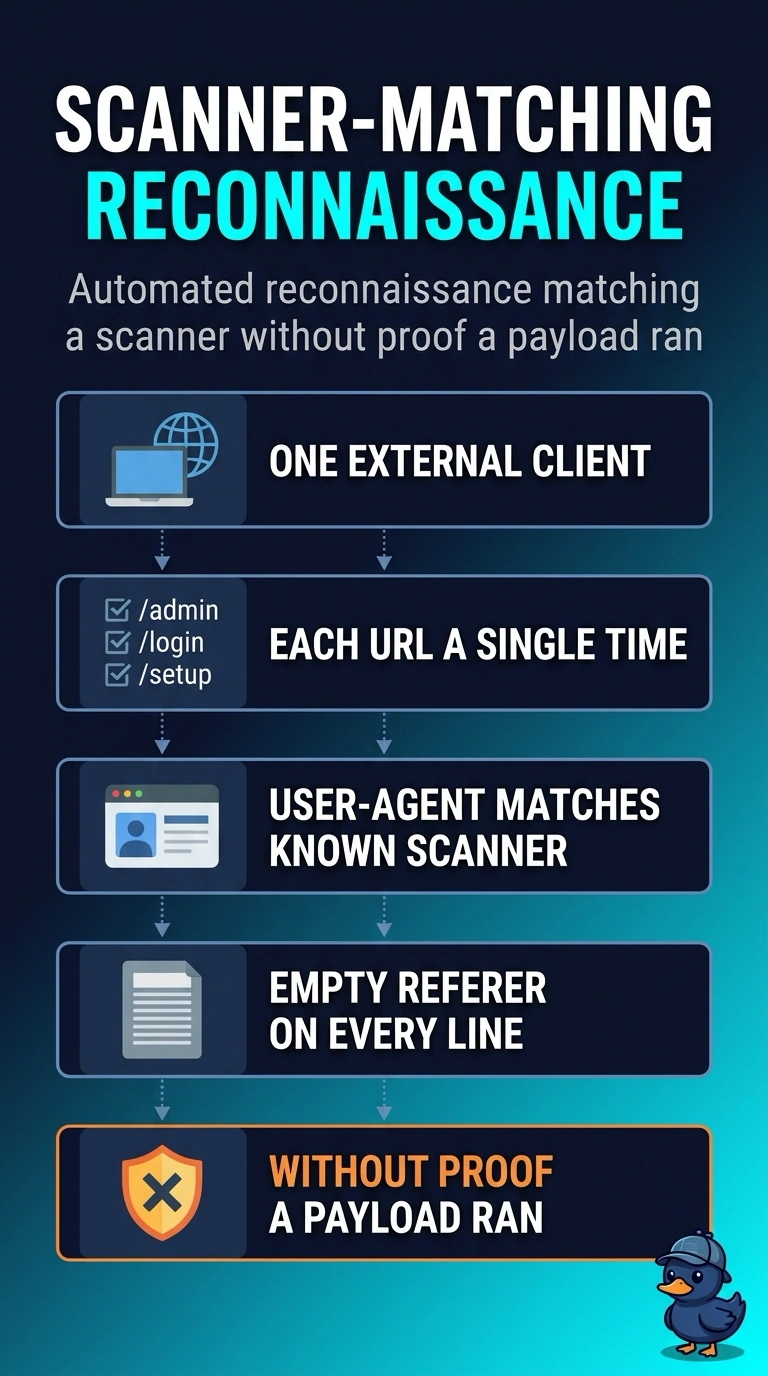
A clinic web server recorded one external client requesting each URL a single time, with a User-Agent that matches a known scanner and an empty Referer on every line. How should an analyst label that traffic?
Select an answer to reveal the explanation.
Short Explanation
Picture someone knocking once on every office door and never stepping inside — you can note that hallway walk. The pattern is consistent with automated reconnaissance, not proof of compromise; User-Agent is client-controlled and Referer may be absent in legitimate browsing. You still avoid treating a status code as proof a payload ran.
Full Explanation
An access log records the request and the status the server returned. It does not record that a payload ran. The pattern is consistent with automated reconnaissance, not proof of compromise; User-Agent is client-controlled and Referer may be absent in legitimate browsing. Confirmed compromise inferred from status codes overstates the log, because a returned status, even a successful one, only means the server answered the scanned URLs. Ordinary browsers may suppress Referer and use cached resources, so missing headers and request uniqueness alone are not definitive. With a scanner User-Agent and systematic one-hit enumeration, ordinary browsing remains the weaker fit. Denial-of-service flooding is volume meant to exhaust the service, not one client that requested many distinct URLs a single time. Exam caveat: scanning can open a real intrusion, so the source and the URL list still belong in the timeline, but this pattern alone stays a hypothesis to corroborate. Operational check: group the access log by client, confirm the User-Agent, the empty Referer, and one hit per path, then compare those status codes with the error log before you call it a compromise.