
A script recovered from a software firm is obfuscated with character codes, and a draft report already states what the author intended. Why should that script be decoded before the intent is written?
Select an answer to reveal the explanation.
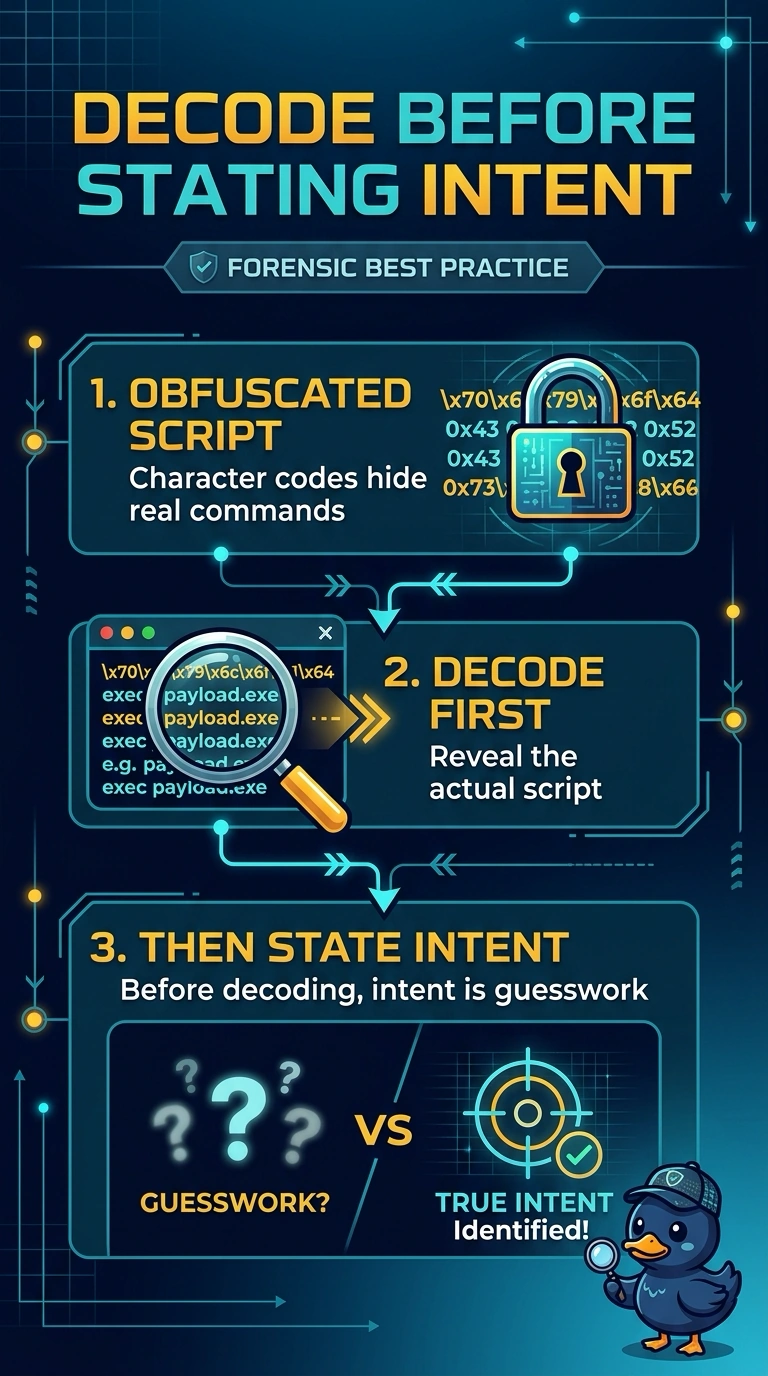
Short Explanation
An unopened letter written in code cannot tell you what the sender asked for. You decode the character codes before the intent is written, because those codes hide the real commands and a guess is not a finding. Quoting the scrambled text, or trusting a hash alone, leaves the behavior unstated.
Full Explanation
Character codes are an encoding that hides the real commands behind numbers or escape sequences. Until the script is decoded, stated intent stays guesswork about a wrapper that has not been opened, so the draft should not claim what the author meant. Treating character codes as encryption confuses a reversible disguise with a cipher, and decoding them does not prove the person who authored the script. A reader who has not decoded the script is describing the disguise, not the commands. The report should not quote the codes unchanged and skip any statement of intended behavior; the codes are the disguise, and the behavior is what the decoded commands do. Decoding cannot be skipped once a file hash matches a known clean software installer package; a hash may identify a file, and an obfuscated script still has to be read before behavior is asserted. Exam caveat: decoding reveals the commands in the script, and it does not by itself prove that script ran on a host. Operational check: decode a lab copy of the character codes and compare the resulting commands with the intent sentence before the report is finalized.