
A Threat Grid report on a factory sample shows a long sleep and no payload behavior. Why is that run inconclusive, and what interactive option does Threat Grid provide?
Select an answer to reveal the explanation.
Short Explanation
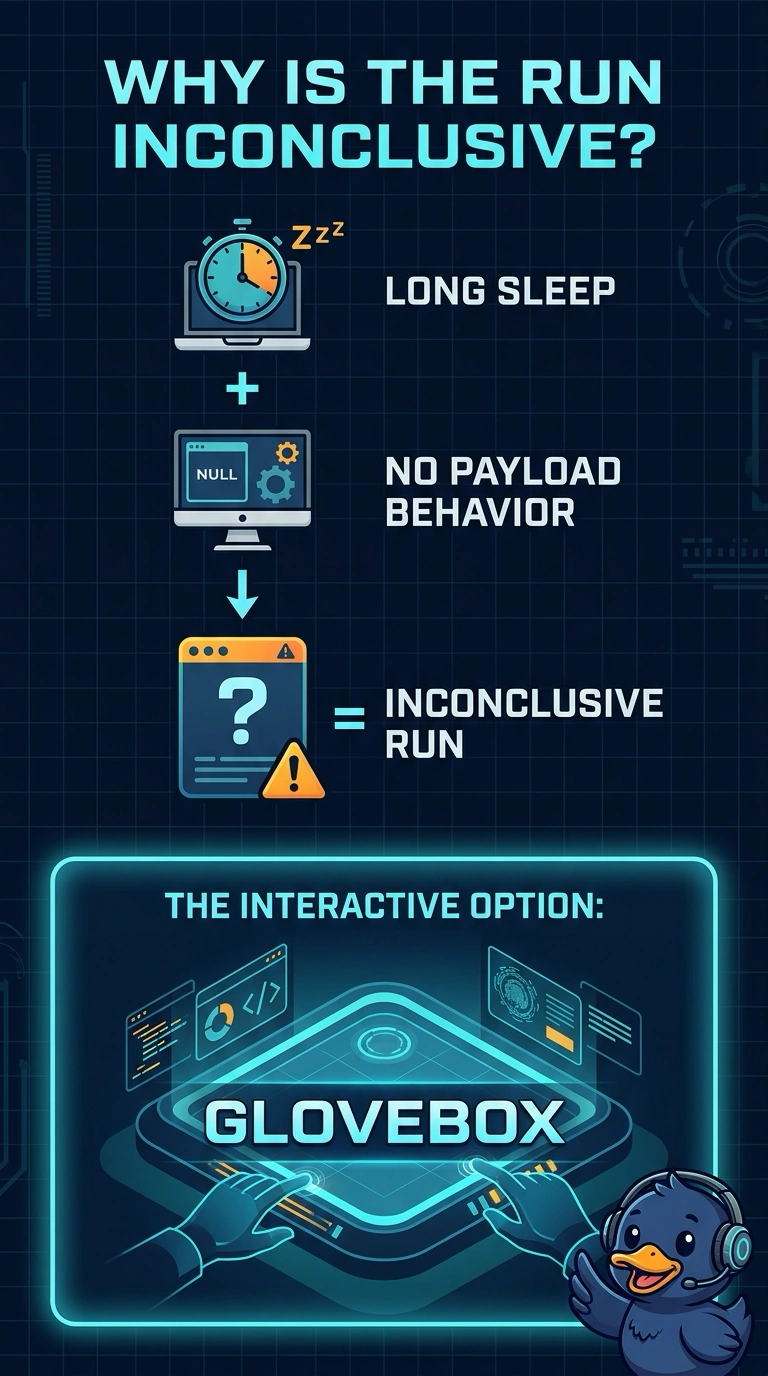
A quiet interview does not clear the person who refused to talk. You should treat a long sleep and no payload behavior as an inconclusive run, then use Glovebox, the interactive option, to work with the sample. Silence is not a clean result, and it is not proof of ransomware either.
Full Explanation
Automated sandbox time is limited. A long sleep and no payload behavior leave the run inconclusive, because the sample can delay its payload until that window closes. Glovebox is the interactive option in Threat Grid, which Cisco also calls Secure Malware Analytics: an analyst opens the sample environment and interacts with it, such as clicking a prompt the automated pass did not reach. No payload behavior does not mean the file is clean, so the sample should not be closed as a benign program with no further work. Missing behavior is not a benign disposition. The long sleep proves nothing about encryption by itself, and the sample should not be treated as active ransomware unless indicators show the sandbox disk being encrypted. Choosing to repeat the same automated run and treat continued silence as proof that the sample is malicious repeats a blind window. Silence is not a conviction. Exam caveat: a threat score only summarizes behaviors that were observed, so a quiet run has little to summarize and the score is not a substitute for the missing activity. Operational check: read the behavioral indicators and the process list, note the sleep and the absent payload activity, and use Glovebox where that interactive session is available.