
Sanitation engineers explain that FHRP protects the first hop for hosts on a VLAN. How does that scope differ from a dynamic routing protocol?
Select an answer to reveal the explanation.
Short Explanation
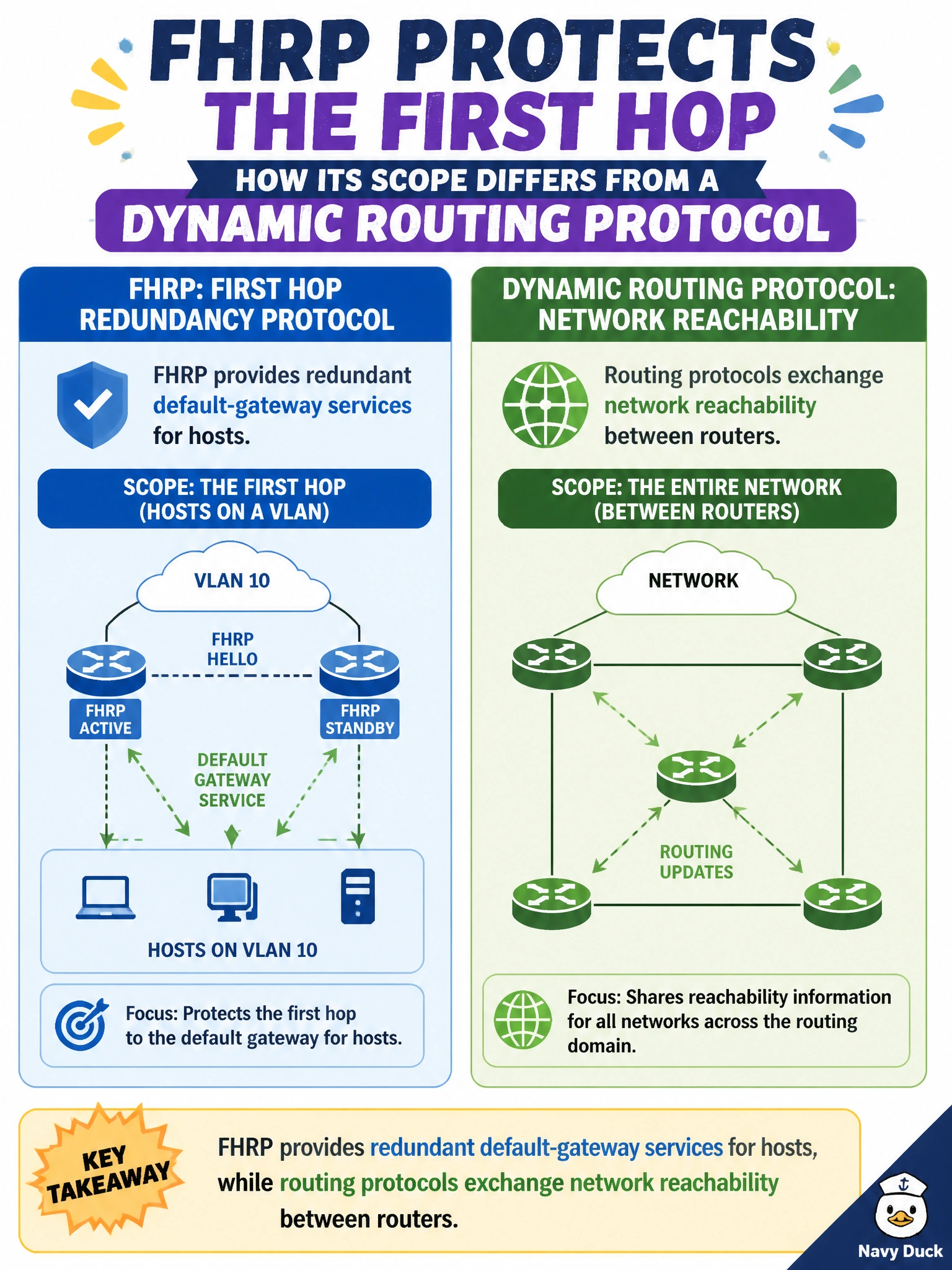
FHRP is the spare key for the front door on the VLAN—host default gateway redundancy. OSPF (and friends) are the road maps between networks. Sanitation should not treat FHRP as a routing-protocol replacement.
Full Explanation
Sanitation engineers correctly scope FHRP as first-hop protection for hosts on a VLAN: it provides a redundant virtual default gateway. Dynamic routing protocols such as OSPF instead exchange network reachability and topology between routers across the municipal network. FHRP keeps PCs forwarding to a stable gateway; routing protocols build the path beyond that first hop. Keeping those scopes distinct prevents treating gateway redundancy as a substitute for inter-network routing.
Claiming FHRP replaces OSPF entirely and advertises every remote municipal prefix by itself fails by concept: FHRP does not flood remote prefix LSAs or replace an IGP. Saying FHRP and OSPF are identical and both only elect Designated Routers on point-to-point links fails by concept: the protocols differ, and point-to-point OSPF typically skips DR election. Asserting dynamic routing only works when FHRP is disabled on all interfaces fails by concept: FHRP and IGPs routinely coexist on campus edges.
Exam caveat: exam items often test whether you know FHRP is host-facing first hop while OSPF/EIGRP/BGP are router-facing reachability. Operational check: on a sanitation access VLAN, verify hosts use the FHRP VIP while upstream routers still run OSPF for remote prefixes—both should be present and healthy.