
Police records staff consider giving half the bureau PCs gateway A and half gateway B with no redundancy protocol. Why is an FHRP virtual IP a better first-hop design?
Select an answer to reveal the explanation.
Short Explanation
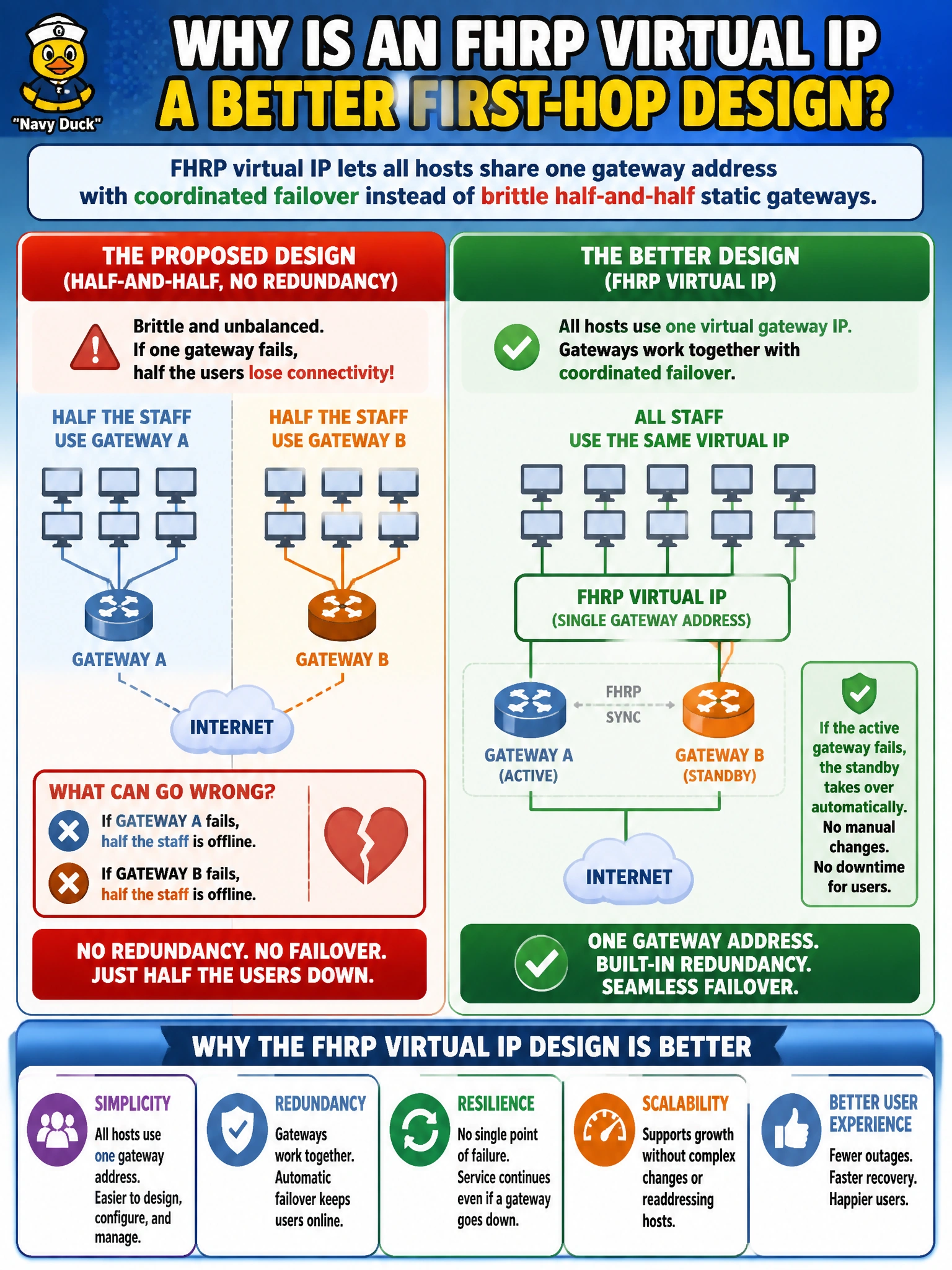
Splitting the bureau—half on gateway A, half on B—means a router outage stranding half the desks every time. One FHRP VIP for everyone is cleaner: same address, coordinated failover. Skip the brittle half-and-half plan.
Full Explanation
A planning bureau that previously split clerks—half with gateway A and half with gateway B—creates uneven failure domains: when A fails, its half loses first-hop reachability even if B is healthy. Preferring an FHRP virtual gateway gives every desk one shared gateway address with protocol-coordinated failover, so either router can protect the whole VLAN. That design is more resilient and simpler operationally than brittle half-and-half static gateways.
Claiming FHRP is required only for IPv6 and cannot protect IPv4 default gateways fails by concept: FHRPs are widely used for IPv4 (and can apply to IPv6 depending on feature), so IPv4-incapable framing is wrong. Saying static split gateways automatically elect a DR/BDR for ARP suppression on the VLAN fails by concept: OSPF DR/BDR is not how host default-gateway redundancy works, and splits do not elect OSPF roles for ARP.
Exam caveat: FHRP answers “one gateway IP for hosts with router redundancy”; OSPF DR answers “LSA focal point on multi-access router segments”—do not conflate them. Operational check: migrate bureau DHCP scopes from split router IPs to a single FHRP VIP, fail each gateway in turn, and confirm all clerks retain Internet/intranet first-hop access.