
A wastewater plant schedules maintenance on one gateway router serving the public-health VLAN. How does FHRP help operations during that window?
Select an answer to reveal the explanation.
Short Explanation
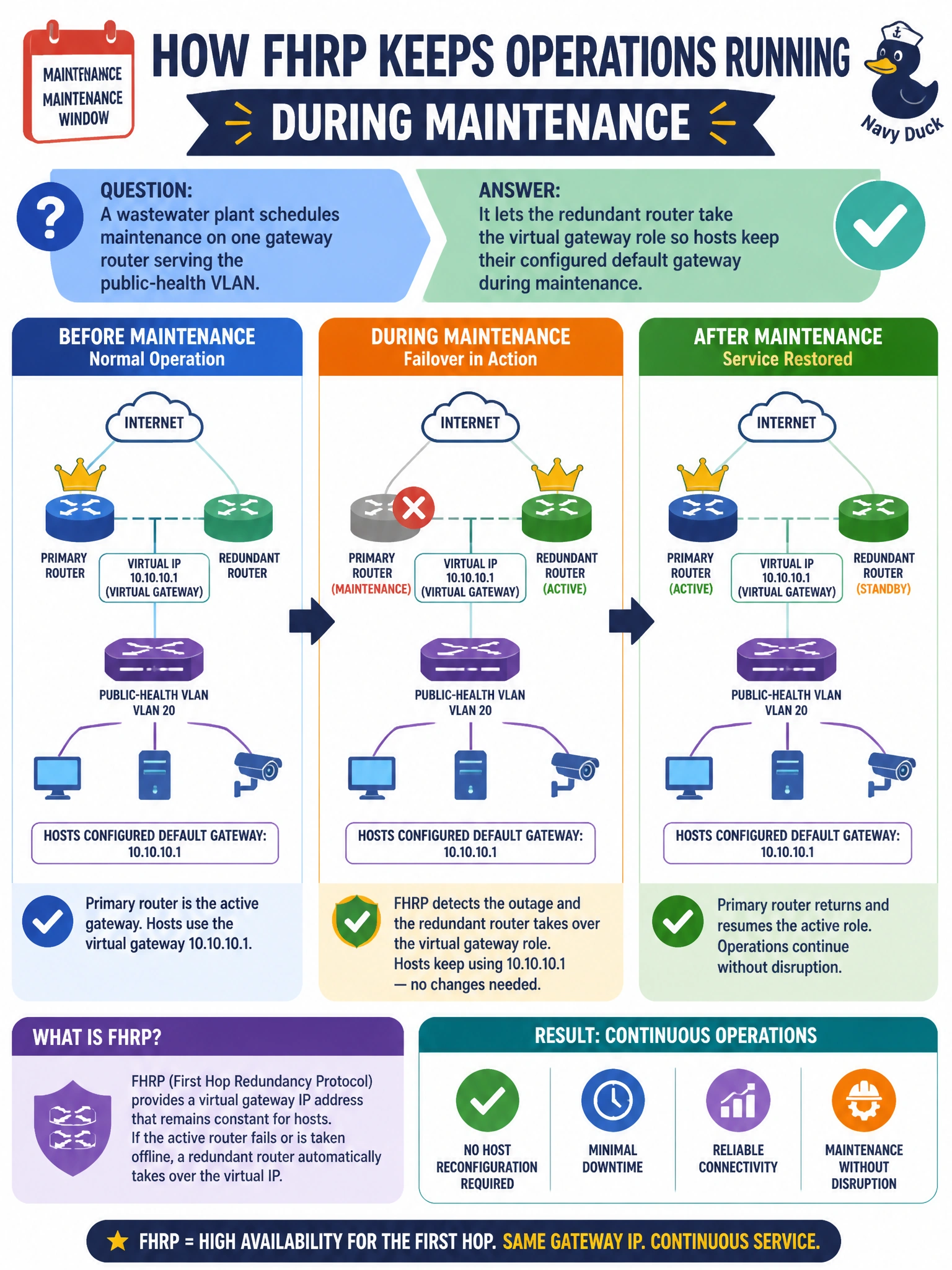
Take one gateway into maintenance and FHRP hands the virtual gateway badge to the other router—public-health PCs keep the same default gateway setting. No plant-wide DHCP gateway rewrite party required.
Full Explanation
During wastewater-plant maintenance on one gateway router for the public-health VLAN, FHRP lets the redundant peer assume the virtual gateway role so hosts keep their configured default gateway. Operators can take the maintenance router out of active forwarding without a plant-wide DHCP rewrite or static gateway change on every PC. That maintenance-window continuity is a primary operational benefit of first-hop redundancy.
Forcing every PC to renew DHCP with a new gateway before maintenance can start fails by concept: FHRP exists so the gateway IP stays the same. Rewriting static routes on all access switches to point at the out-of-service router fails by concept: you should steer away from the router under maintenance, and access switches often are not the host default gateway. Disabling the VLAN until both routers are simultaneously forwarding fails by concept: FHRP is designed for continued forwarding with one active virtual gateway owner.
Exam caveat: pre-stage priority/preempt policy so return-from-maintenance behaves predictably and does not flap unexpectedly. Operational check: lower priority or shut the maintenance router’s VIP participation, confirm the peer is active for the public-health VIP, proceed with maintenance, then restore and verify desired active ownership.